We're here. It took twenty-one days almost to the hour from sailing past the lights of Cabo San Lucas to landfall in Nuku Hiva. Yes, with a one-year-old cooped up in the boat for every one of those twenty-one days. But Elias actually did great, and the passage was a steller event for all of us.
Our internet access here is not good. There won't be many emails coming from us over the next few weeks, but hopefully the blog will allow us to share some of the experience effectively. We have some great pictures, but I'm not going to try to upload them via this bad connection from the boat, so for now you'll have to settle for some notes that I wrote up at sea. More to follow soon.
-Mike
***
To the Trades
April 7, 2008
5° 20′ N, 129° 41′ W
Day 13
Time blends into itself and flows away unbidden. I try to get in the habit of entering our location, course and speed in the log every four hours, but in this lazy era of constant updates from the GPS I find that entire afternoons melt away unchronicled.
Mixed sea salt, dried sweat and old sunscreen covers us all. The settees are sticky with it. My harness bears a big grease stain from rubbing up on my neck. My shirt is inexplicably falling to pieces, giant rents opening up in the back.
We are as alone on the face of the planet as we could be, barring a trip to the Southern Ocean, or the heart of Antarctica, or something silly like that. It’s been a week since we laid eyes on a ship, and of the 25 or so Marquesas-bound yachts that we are keeping in touch with via ham radio, the nearest are more than 150 miles away.
Every day we are surrounded by a heaving expanse of ocean. When the sun is shining, the water is a mythical blue, the color of the earth as seen from space. Under cloudy skies the water is a gray that makes me think of the Bering Sea. But I know that if I had a picture of the Bering Sea in hand I would drop that comparison. We are intimate with the three or four waves that are always right behind us, always just about to sweep under our stern and make us grab onto something as the barky rolls under our feet. The long series of other waves and whitecaps that reach to the horizon and will never touch us are abstract, they have nothing immediate to do with us. I stand up on the bow and watch them for half an hour at a time, mesmerized.
At night, if the wind and waves are low, the three of us in our little boat cabin could be anywhere. The motion is gentle, and I have to remind myself of the indifferent vastness outside. While we eat our dinner and get Elias ready for bed, Pelagic does the work of hurrying us along to Australia. That’s one of the great qualities of our boat, and of any capable cruising boat, the ability to cover miles efficiently without constant attention from us. For 24 hours after we left the lights of Cabo San Lucas behind us, I was sick, barely able to get up from my bunk. That left Alisa looking after both Elias and the boat. She was able to do it, going on deck now and again to reef the main or shake a reef out. Otherwise the windvane steered and the boat sailed and everything was fine.
We had light winds on the way down to Cabo San Lucas from La Paz, but as soon as we rounded the tip of the Baja peninsula we picked up a stiff northwest breeze that blew for days and spit us out far into the open ocean. It was a surprise that first night out of Cabo to be rolling gunwhale to gunwhale in a beam sea and putting a second reef in the main. The first days out of sight of land were blue and clear with occasional ships. The northwest breeze carried us all the way out to the northeast trades. (The tradewinds north of the equator blow from the northeast, those in the southern hemisphere from the southeast.)
Neither Alisa nor I had ever sailed in the tradewinds before. It was something we had often daydreamed about, the first-hand reports that we had heard painting visions of languor, sunshine and speed, the sheets eased and never adjusted for weeks at a time as the trusty little cruising boat reels off mile after mile. The reality is, as always, a little different. We have been fighting a contrary current for much of our time in the northeast trades. In addition to slowing us down, the force of this current against the tradewinds has produced a steep swell that has the boat constantly swinging back and forth and occasionally tripping down the face of a particularly big wave, landing in a roar of whitewater.
During past passages on Pelagic we have kept a constant lookout, but the outer limit of our endurance for trading off watches during the night and then keeping up with an energetic one year old during the day is about one week. After that the fatigue becomes too much. We can only sleep when Eli sleeps, and if one of us is always on watch that leaves us splitting eight or nine hours of sleep at night and an hour or so during his nap time. We just couldn’t maintain that schedule for the entire three or four weeks of a passage to the Marquesas.
The solution was suggested to us by our friend Elie, who with his Gallic certitude says, “If I cannot sleep, I WILL NOT CRUISE. We set the radar alarm at night and both of us sleep. For us it is the ONLY way.”
There is a strong taboo in the American cruising community, or at least that part of it that expresses itself in sailing magazines, against not keeping a 24 hour lookout. And there is no doubt that it is proper seamanship to keep a constant lookout. But what I like about Elie’s approach to sailing the expanses of the world is that he is not afraid to find his own solutions to the various problems that come up. Alisa and I talked it over and decided that sailing with Elias in a sense makes us quasi-singlehanders, since he demands nearly constant attention from one of us, leaving only one person to mind the ship. Singlehanders of course cannot keep a constant watch, yet most of them seem to make it where they’re going. And so, while we stayed up during that first rolly night looking out for coastal traffic while the lights of Cabo faded from view over the stern, every night since then we’ve turned the radar alarm on and both gone to bed.
We both wake often during the night in response to changes in the barky’s motion or flapping of the sails, and sometimes I spend half the night in the cockpit, adjusting sails and the windvane or keeping an eye on passing squalls or ships. Those might be the most impressive moments of the trip. I jump out of my snug sea-berth and clamber up the companionway steps, half asleep and wondering what is going on. Out in the cockpit there is only the faint glow from the compass, the wind and speed instruments and the masthead light. Everything above me is stars and the negative space of clouds. On both sides of the boat invisible water is rushing by with a hiss. One of the really neat things about the low freeboard and narrow stern of Pelagic is times like this, when the ocean is so immediate. I always experience a brief shudder of realization when I step out into the cockpit at night, especially if we’re heeled over so that the water is below me. The water is death, pure and simple. If I fell in I’d never be found. It’s sort of the same feeling that you get from looking down from some ghastly height. Freudians argue that dizzying heights and black waters swirling past your cockpit on moonless tropical nights are both horrible to behold because they offer the immediate contemplation of death and the potential for suicide. But all this is a bit macabre, and I’m not aware that anyone takes Freudians seriously anymore, anyhow. I just make sure that my grip on the steering pedestal is extra firm as I walk along the cockpit seat to reach the helm.
Alisa and I both have the high-latitude biologists’ contempt for tropical oceans as biologically barren outside of coral reefs. So we’ve been surprised at the amount of bioluminescence in our wake at night – a solid river of green-gold snaking after us as we sail down wave after wave. It sure looks like there’s a lot of plankton in these waters.
I sit behind the wheel on these starry, moonless nights, keeping an eye on the compass and occasionally tweaking the windvane, the wake behind me the color of starlight and stretching unbroken all the way to Mexico, and I begin to feel the scale of this ocean, and of our trip. The world may be shrinking culturally; we’re likely to find Michael Jordan t-shirts in the Marquesas, and our position is being updated on the web throughout the passage for people back home to track. But there is also an irreducible mass to the earth’s geography. This ocean, mile for mile, is as big for us as it was for Magellan, or Cook, or the Polynesian navigators.
***
Another thing that we have in common with the Polynesian seafarers, but that Magellan and Cook never thought of during their voyages of discovery, is toilet training. We’ve made the switch from disposable to cloth diapers for the duration of our crossing of the Pacific, and our sudden inability to throw away diaper bombs and forget about them has made us keenly anticipate the day when Elias will be diaper free. The how-to guide for child rearing that we have on board suggests that the first step is to build your child’s awareness of bodily functions, with an eye towards reaching the point when he can tell you that he’s gotta go. So “pee” and “poop” are suddenly leading members of our lexicon. Sometimes, as we undertake this bold crossing of one of the great expanses of open water on our planet, as we follow the trade wind paths that sailors have used ever since the dawn of navigation on the Pacific, as we aim for the tiny isolated gems of islands that have stood in for our culture’s notion of an earthly paradise ever since the eighteenth century, it seems that all we talk about is pee and poop.
To the Line
April 11, 2008
0° 19′ N, 131° 23′ W
Day 16
Nineteen miles north of the equator. It’s one in the morning local time, and we’ll cross the line some time before dawn, after Alisa has taken over the watch. We have been motoring for long stretches through the doldrums – thirteen hours and more at a whack. And, more predictably than I would care to admit, the autopilot is down. As near as I can figure, the problem is a spike in voltage from the alternator through the full batteries. Beyond my level of understanding, and the solution certainly beyond us here in the middle of the watery world. The wind vane works great when we sail, so no problems when we have wind. On the way down the west coast of North America we used a small autotiller in combination with the windvane to serve as an autopilot when we motored, but the vibration of the propwash and the action of the autotiller’s electric motor shook the poor windvane so badly that all of its welds began to fail. So that’s out of the question now, and we’re back to hand steering, just like we did on that endurance fest of a seven-day passage from Coronation Island, Alaska to Neah Bay, Washington, when the various autopilots were not working and we motored for days against very light headwinds, bleary-eyed and semi-rational behind the wheel.
That trip was seven months ago. Before Elias could walk, and while we were still in the very difficult transition from land life to life afloat. Seven months ago, but enough has happened since then to fill a decade or so, it seems, of our old life.
The steering isn’t very demanding, we just look at the compass every couple of minutes and make a little correction if it’s needed. We can read, or write in our journals. But we’re also chained up here, in the cockpit, through the day and through the night. Until the wind returns.
***
The equator, at sea.
These four words bring to mind a picture of a painted ship on a painted sea. Blinding light, merciless heat, a stifling atmosphere forever devoid of profitable wind. Our experience, as ever, has diverged from expectation.
Crossing the equator, as we are, to get from the northeast trades to the southeast trades, involves crossing the intertropical convergence zone, or, in our era that is so short on poetry and so long on acronyms, the ITCZ. The ITCZ is dominated by convection cells that have the potential to produce really rotten localized weather, interspersed by the flat calms of the doldrums. We sailed a southwesterly course in the northeast trades to 130° W, where the ITCZ is at its narrowest north-south extent. Then, at about 5° N, the northern limit of the ITCZ, we changed course to due south in order to cross the ITCZ at right angles and spend as little time as possible in the area of disturbed weather. The convection cells form and dissipate too rapidly for a slow-moving vessel such as ourselves to steer a planned course through them. So at 5° N, 130° W we turned south and touched wood for a good crossing. Alisa called a west coast sailing weather guru named Don Anderson on the ham radio the morning that we changed course south, asking for current information about the extent of the ITCZ. He told her that boats crossing in our longitude in recent days had experienced 35 knot winds, torrential rain and zero visibility in a 200-mile diameter convection cell. (Thirty five knot winds are officially Like Fun, But Different.) He figured our chances were fifty-fifty of hitting the same weather.
Which brings me back to my old vision of the equator as flat calm and brutally sun-drenched. What we find as we sail and motor south is a zone of flux and disturbance, random seas and towering clouds. We’re at the heart of the world, the center of things. Long lazy swells roll in from both hemispheres and meet here in an undulating sea, like the breathing of the world. This is also the earth’s furnace: huge volumes of hot air go rising up and spread north and south at incredible altitudes to drive the weather over a vast swath of the planet. It’s a furnace, but not a basement furnace; an airy, ethereal furnace as befits this planet of ocean and atmosphere. Enormous stacks of cloud rest on the horizon all around us.
On our first night in the ITCZ we sailed through the first squalls of the trip. The radar alarm went off and when I got up to look I saw tight little weather targets clustered in front of us, soft on the edges unlike ship targets, but black and impenetrable in the center. I sat at the chart table for twenty minutes, stupid with sleep, wondering if we would get past them or not. Then I stirred and put a second reef in the main, insurance against any sudden increase in wind strength.
Shortly after I reefed, at two in the morning, it started pouring rain – the first rain that we’ve had on deck since San Diego, in December. I huddled in the companionway in a jacket, the hatch boards up to keep the rain out of the cabin. It was suddenly cold, only a couple hundred miles north of the equator. I looked at the compass and tried, with my sleepy brain, to understand a fifty degree windshift. The windvane steers a course relative to the direction of the wind, so when the wind changes direction, so do we. I began an endless round of adjusting sails, reefing, easing, sheeting, shaking out, as the wind blew from five knots to twenty and half the way around the compass. I worked the sails and tweaked the windvane, trying to bring the boat’s disparate parts together to channel this incoherent wind into a steady course south. Finally, the wind settled into fifteen to twenty knots on the beam, the ingredients for a heroic sail. The rain eased to a drizzle and I stood at the helm in my jacket, watching the illuminated compass dial for evidence of the windvane’s ability to keep us going where we want to go.
The world is froth and low light. Our wake shakes the bioluminescent plankton to life so that each wave crest glows back at me in the exact same ghostly green as the compass light. The motion is exquisite. I, who am forever resistant against metaphors of sailboats as living things, am enmeshed in the dance that Pelagic dances, picking us from trough to crest as waves come at us from three or four different directions at once, legacy of both the recent wind shifts and the opposing prevailing winds in the two hemispheres of the globe, hundreds of miles on either side of us. Sometimes our motion is gentle, the boat rising buoyant at just the moment to let a whitecap slide through. Other times we put our shoulder down and push through ten thousand pounds of water coming at us at ten knots. Spray leaps into the cockpit and is washed clean by the rain. I hold onto the pedestal and swing back and forth with each roll, now on a flat deck, now suspended out over the rushing ocean. Jellyfish come sliding by, their big saucer-shape bioluminescent signatures as monuments in the green lawn of the plankton’s background glow. The clouds overhead thin. Stars shine through. A flying fish hits me in the back of the leg and rattles around in the well of the cockpit, scaly and crisp from the ocean. I’m no longer needed, the wind is steady and Pelagic is well on course. But I stay at the helm, watching this display of the world as it is, this verity that I have not once seen.
Finally I put a reef in the main to give myself even odds of sleeping the rest of the night through and retire, reluctantly, to my damp bunk. I wake a few hours later to hear Alisa saying, “Shhh, Daddy’s sleeping.” The cabin is alive with a thousand suns’ light. Our motion is gentle, the wind almost gone. Elias is peering over the lee cloth to my bunk, finger to his lips, saying “Thhhhh!” in his one-year-old’s imitation of a shush.
Eli is, not incidentally, doing very well with the passage. He is covered by sweat night and day, leaving great salty puddles on his pillow at night, his hair plastered to his skull all day. Poor little Alaskan boy in the tropics. But he is also suddenly starting to imagine, and to act out his imaginations. He pretends to catch fish with a short line dangled from the settee to the cabin floor: “Boom, fish!” he yells over and over. He pretends that his stuffed dog and puppy eat the birds off the page of our guide to the birds of the tropical Pacific. When we heel over with the spinnaker making the most of a light breeze before the beam he leans forward to walk up to the high side of the salon, like a man walking into a gale, then jumps in the air and goes running downhill into his mom’s lap.
And he suddenly picks words out of our sentences to repeat. “Bonk!” he says. “Grease!”
Sunday, April 20, 2008


Monday, March 24, 2008
Baja-o-rama
Hmmm... cruising with a one-year-old doesn't leave a lot of "spare" time - who woulda guessed it? To make up for the paucity of posts from Mexico, here is a parting barrage of pictures (if this dicey wifi connection allows).
While I'm thinking of it, a story from earlier in our trip is in the March issue of Pacific Yachting magazine, so if you're in the Pacific Northwest, pick up a copy.

Alisa's parents had a great visit in La Paz, including a sail in perfect conditions.
 Elias got to play with his cousin Kali.

My folks came out for a sail, too. Here Dad steers while Mom navigates.

Dad reading to Elias.

My Mom taught Eli to sing "Row Row Row."

Jamie and Kelly came down from Haines for a week-long sailing/kayaking trip.

The three guys got in some birding time.

Jamie made a big impression; Elias still says "Jamie!" about twenty times a day.

Jamie kayaking...
...and Jamie sailing.
 This is the yellowtail tuna that we finally caught, after much effort.
This is the Rose, way back in January, as we were on passage around the southern tip of the Baja.

Elias continues to love to read. He's now more interested in our books than in his own. Field guides are a particular favorite.
Magazines are good, too, though he almost exclusively looks for pictures of dogs and horses. This picture was taken on our first day in a place called Ensenada de Los Muertos, where we ended up spending a LOT of time. (And it's where we are now, anchored up on the start of our trip to the Marquesas.) We had beat against 20-25 knot winds to get to Los Muertos, with lots of water on deck, and a persistant deck leak had soaked these cushions. We finally tracked that leak down when we were in La Paz, and the boat is really starting to feel dry.

This is Los Muertos from above.
 We spent a lot of time on the beach at Los Muertos. Check out Eli's wet suit.

Elias loves the beach.

He really loves the beach - he asks to go there every day.

This is the beach on Partida Island where Jamie and Kelly were camped - a great intersection of desert and sea.

The view from the top of Partida, looking over the Sea of Cortez.
Alisa and Elias on the beach.

Cacti...

...cactus.
 Pelagic anchored among the cacti.
 Trying to seal the mask around the ever-growing beard.
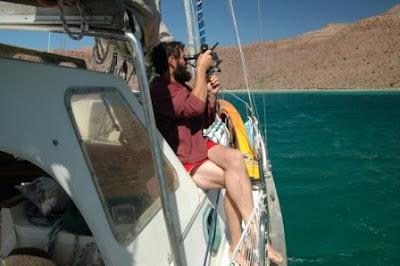 Practicing with the sextant for the ocean passages ahead.
Fast friends, fast. We met Megan and Brian from Nomad and hit it off quickly. They're heading down to Central America this year and are bound for New Zealand in 2009.

And then there were the jobs. I made deadlights (storm windows, basically) for the Pacific crossing.
 Alisa racked up big hours on the sewing machine. Here she's making a sun awning for the boat.
Here she's making a wind scoop to bring refreshing breezes below in the stultifying tropics.

Here she's patching the sails for the rigors of tropical squalls and convection cells.

I installed a rebuilt anchor roller.

And went up the stick to check on a few things.

We're not sure who this character was, but he seems to have fixed the wind vane.

That's it!
Paradise Can Wait
Every step of this trip, we’ve left port later than we planned. Kodiak, Port Townsend, Alameda and San Diego all kept us weeks longer than expected, as we simultaneously worked on boat chores and raised Elias. We got used to being slower than we liked, and grew philosophical about cruising with a one year old. Sailing with Eli might be slow, we told ourselves, but it’s a lot faster than staying home with Eli.
But for the big trip that we’re about to embark on, the three- to four-week passage from Mexico to the Marquesas, we promised ourselves that things would be different. We would be ready the day we wanted to go, ready to grab every precious moment of the hurricane-free season in the South Pacific.
Well.
We planned on being ready to go March 10th. We left La Paz yesterday, March 22nd. There were some extenuating circumstances, as all three of us got sick. We sat on the hook for days after my family left last month, with both Elias and Alisa sick with fevers and respiratory track infections. And then I got sick last week in La Paz, and so had to lay around the boat for days with a fever when I was burning with eagerness to get Pelagic prepared for the monster trip ahead of us. And when we were well we were, as always, working on the boat with one hand and caring for Elias with the other. The good news is that we didn’t get at all frustrated with the slow pace of things as we have in the past, even as we watched other boats leaving La Paz for the Marquesas and started to hear them reporting their positions and weather over the ham radio.
Our path from the southern tip of the Baja peninsula to the Marquesas will take us through four distinct weather systems: the non-tradewinds weather off Mexico, the northeast trade winds of the northern tropics, the squalls and doldrums of the Intertropical Convergence Zone on the equator, and finally the southeast trades of the southern tropics. It’s a bit of a chess match to get through all these different systems as quickly as possible. We’ll try to make as much westing as we can in the northeast trades, then cross the equator around 130° W, where the squalls and doldrums should be at their narrowest north-south extent. We can make a general plan like that, but since sailboats move so slowly we will largely be reacting to whatever weather comes along. The boats that left La Paz before us found themselves dealing with a real mish-mash early on, everything from fifteen foot seas and 30 knot winds (that’s a lot of weather) to light and variable winds that made steering tough and progress slow. Diesel fuel may not be available in the Marquesas and the Tuomotus, the first two archipelagos that we will pass through in French Polynesia, so except for motoring across the equator, most boats have to sail through light winds and calms to conserve fuel for the atoll entrances that lie ahead.
This passage is really one of the grand adventures offered by the planet. Alisa and I are both intimidated by the unknowns of the new kinds of sailing that we’ll find in the tropics, and intimidated by the sheer scale of the trip, but also entranced by the idea of such a string of sunrises and sunsets on the vast heaving expanse of the sea. I think it will be fun, more than fun. Exhausting, but exquisite.
Meanwhile, our three months in Baja are about at an end. I saw the streets of La Paz with fresh eyes two days ago when I was walking around them for the last time, translating signs to myself and really looking at the foreign scene around me. What a great place. It’s funny how removed from Mexico we have been at times on this trip, as the three of us nestled down on board our little capsule of the U.S. in some anchorage or another. That lingering separation from the place where you are traveling, the lack of full immersion in the foreign culture, is a hallmark of traveling under sail – you naturally spend so much time aboard the boat, living and sailing and maintaining, and then visiting with other people from somewhere else who live on boats like you do. That’s the tradeoff for having your home with you as you see the world.
Which we do. Even though Alaska is far away and getting further, we don’t have any sense that we’re far from home. Pelagic is home. Alisa had a great insight the other day, saying, “I wonder if we won’t be chasing the idea of Alaska when we go back.” We both had such a great time in our twenties and thirties in the Great Land, going through all the traditional seminal experiences from college to grad school to marriage and family, and adding the many many Alaskan-only seminal experiences that involve remarkable people cast thin over an unbelievable landscape. We still plan on going back, but we’ll be in our forties, and seeing life in that new way, and the tone of our lives will be dependent on the old friendships that we can pick up and the new ones that we can find and well, who knows what going home again will bring.
For now we have no thoughts about going back beyond the “someday” kind. Sailing with a one year old is tough, and we talk about cruising for six months a year once we reach Australia until Elias is a little older. But going when we did was crucial, as it got us away when we were still in our thirties, and embracing this new life was (relatively) easy. We now wonder how long it might be until we swallow the anchor and go back to a career nine to five life. Consensus on board Pelagic is that it might be a long long time.
***
We're one day south of La Paz now, and will move further south tomorrow. The forecast is for good winds to carry us away from the Baja peninsula on Wednesday. Internet service is spotty where we are. I'll try to post some pictures from our last weeks in Baja; fingers crossed that it works.
But for the big trip that we’re about to embark on, the three- to four-week passage from Mexico to the Marquesas, we promised ourselves that things would be different. We would be ready the day we wanted to go, ready to grab every precious moment of the hurricane-free season in the South Pacific.
Well.
We planned on being ready to go March 10th. We left La Paz yesterday, March 22nd. There were some extenuating circumstances, as all three of us got sick. We sat on the hook for days after my family left last month, with both Elias and Alisa sick with fevers and respiratory track infections. And then I got sick last week in La Paz, and so had to lay around the boat for days with a fever when I was burning with eagerness to get Pelagic prepared for the monster trip ahead of us. And when we were well we were, as always, working on the boat with one hand and caring for Elias with the other. The good news is that we didn’t get at all frustrated with the slow pace of things as we have in the past, even as we watched other boats leaving La Paz for the Marquesas and started to hear them reporting their positions and weather over the ham radio.
Our path from the southern tip of the Baja peninsula to the Marquesas will take us through four distinct weather systems: the non-tradewinds weather off Mexico, the northeast trade winds of the northern tropics, the squalls and doldrums of the Intertropical Convergence Zone on the equator, and finally the southeast trades of the southern tropics. It’s a bit of a chess match to get through all these different systems as quickly as possible. We’ll try to make as much westing as we can in the northeast trades, then cross the equator around 130° W, where the squalls and doldrums should be at their narrowest north-south extent. We can make a general plan like that, but since sailboats move so slowly we will largely be reacting to whatever weather comes along. The boats that left La Paz before us found themselves dealing with a real mish-mash early on, everything from fifteen foot seas and 30 knot winds (that’s a lot of weather) to light and variable winds that made steering tough and progress slow. Diesel fuel may not be available in the Marquesas and the Tuomotus, the first two archipelagos that we will pass through in French Polynesia, so except for motoring across the equator, most boats have to sail through light winds and calms to conserve fuel for the atoll entrances that lie ahead.
This passage is really one of the grand adventures offered by the planet. Alisa and I are both intimidated by the unknowns of the new kinds of sailing that we’ll find in the tropics, and intimidated by the sheer scale of the trip, but also entranced by the idea of such a string of sunrises and sunsets on the vast heaving expanse of the sea. I think it will be fun, more than fun. Exhausting, but exquisite.
Meanwhile, our three months in Baja are about at an end. I saw the streets of La Paz with fresh eyes two days ago when I was walking around them for the last time, translating signs to myself and really looking at the foreign scene around me. What a great place. It’s funny how removed from Mexico we have been at times on this trip, as the three of us nestled down on board our little capsule of the U.S. in some anchorage or another. That lingering separation from the place where you are traveling, the lack of full immersion in the foreign culture, is a hallmark of traveling under sail – you naturally spend so much time aboard the boat, living and sailing and maintaining, and then visiting with other people from somewhere else who live on boats like you do. That’s the tradeoff for having your home with you as you see the world.
Which we do. Even though Alaska is far away and getting further, we don’t have any sense that we’re far from home. Pelagic is home. Alisa had a great insight the other day, saying, “I wonder if we won’t be chasing the idea of Alaska when we go back.” We both had such a great time in our twenties and thirties in the Great Land, going through all the traditional seminal experiences from college to grad school to marriage and family, and adding the many many Alaskan-only seminal experiences that involve remarkable people cast thin over an unbelievable landscape. We still plan on going back, but we’ll be in our forties, and seeing life in that new way, and the tone of our lives will be dependent on the old friendships that we can pick up and the new ones that we can find and well, who knows what going home again will bring.
For now we have no thoughts about going back beyond the “someday” kind. Sailing with a one year old is tough, and we talk about cruising for six months a year once we reach Australia until Elias is a little older. But going when we did was crucial, as it got us away when we were still in our thirties, and embracing this new life was (relatively) easy. We now wonder how long it might be until we swallow the anchor and go back to a career nine to five life. Consensus on board Pelagic is that it might be a long long time.
***
We're one day south of La Paz now, and will move further south tomorrow. The forecast is for good winds to carry us away from the Baja peninsula on Wednesday. Internet service is spotty where we are. I'll try to post some pictures from our last weeks in Baja; fingers crossed that it works.
Subscribe to:
Posts (Atom)