Showing posts with label reading. Show all posts

Thursday, November 17, 2016

Thinking Up a Hurricane

Good book alert.

We picked this one up in South Africa - a memoir of family sea-going life with a not-so-good father.

The author, Martinique Stilwell, is very good on the child's perspective of how life turns out when parents are derelict in their duties, and how parents make a long series of choices for their children when they decide that it's too much bother to educate them.

The story is from the tail end of the 1970s, when there were a lot more parents out there happy to let their children grow up (euphemistically) free and (actually) ignorant. But the book does offer an interesting perspective for contemporary parents disinclined to put  effort into their kids' education.


Saturday, March 22, 2014

Setting the Record Straight

Well, I wasn't going to bring it up - but Michael of Del Viento mentioned it in a comment the other day.

There was this article in one of the sailing rags this month.  Completely typical copy for this sort of publication - dreamy-eyed, soft-focus stuff about the "cruising life".

The factual misrepresentations were legion - just to begin with, our family is described as "personable".  Believe me, nothing could be further from the truth.

We've submitted a rebuttal to the editors...


~~~~~~~~~~~~~


-Hmm.  Was the stuff you wrote for that magazine dreamy-eyed and soft-focus?
-Yeah, well.  It's kind of a joke.  You know.
-We've been married twelve years and I still can't tell when you're joking.
-That's what I wonder about.  Online and all, you know, people have such stringent mental filters for evaluating what they read.
-You're joking.
-Right.  (sigh)

Monday, January 6, 2014

Sod That

I'm deep into the science work - non-metric multidimensional scaling, if you want to know, and I'm clearly missing something important while I'm at it.

Alisa, to more discernible effect, is stripping down the winches.  Annual service is barely adequate for these beasts if they live on a traveling boat.

Our holiday, in other words, is well over.

We've got three months to get our acts together for Patagonia - come April 1, we want to be ready to rock on out of here.  I, of course, am also finishing that mid-career PhD and madly writing proposals for more research gigs to pay for all this nautical carrying on.  Blog posts might be a little…terse…in the short term.

Occasionally the one of us has the common-sense idea that we should just chill out and head straight to Patagonia instead of doing a season in French Poly beforehand.  That way we could stay in New Zealand until October and get everything ready in an orderly way.  The very idea occurred to me only last night, as I made the mistake of trying to figure out our cabin heater installation at the same time I was figuring out the installation for the solar panels.

But rest assured that this common-sense idea has been vigorously opposed.  Sod that, as one of our more English friends might say.  Permission for an orderly approach denied!  We're going to Rapa, and that's it.

So, with a full few months ahead of us, we particularly enjoyed our recently-completed holiday dawdle out to Great Barrier Island, during which we did nothing useful at all.

To whit, some pictures:

I read The Hobbit to Elias recently, but had thought we might wait until he was a bit older before tackling The Lord of the Rings.  But then he found a one-volume edition in the marina book swap - it was clearly meant to be

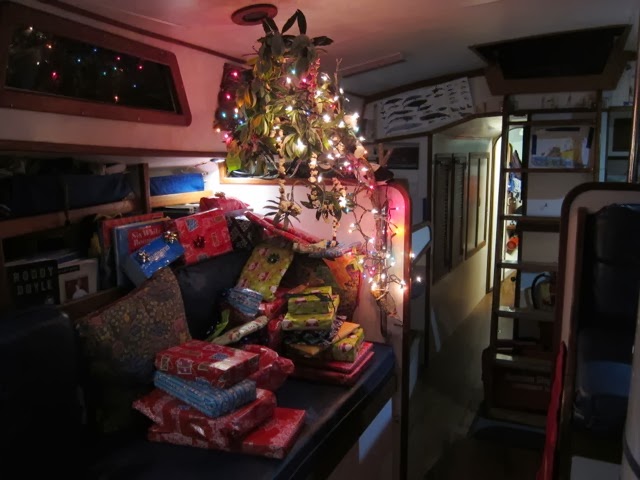
New Zealand conveniently has a native Christmas tree - the pohutukawa.  A branch from the beach did nicely for us

The finished effect

Alisa made a Christmas stollen from my grandmother's recipe
Elias got mad into the gift-giving spirit this year.  Above - pressies wrapped and labeled for Santa, "Misses Claws" and Santa's dog...
Christmas morning with young children - an early start, and mad joy
A shield and battle axe…two of the many gifts that Elias made or purchased for Eric
Elias' gift for me - a tape for measuring fish.  You can see how happy he is that I like it so much...
The best three bucks we ever spent
This is what happens when you win the Booker - husbands and wives each give each other a copy of your 800-page novel as Christmas presents 


Great Barrier provided plenty of on-shore recreation.  The bird community may be hurting,  but the walking tracks are impossibly good
We managed to beat both down to Great Barrier and back to Whangarei Heads.  Reef, shake it, reef, shake it...
Soon-to-expire satphone minutes were used to call grandparents

We ended the holiday at Ocean Beach.  Some chance acquaintances who settled at Whangarei after decades of sailing the world rowed up to Galactic to ask if they could drive us to the beach and lend us boogie boards.  People who have traveled themselves are so incredibly hospitable to travelers.  These are the same people who brought the gift of ice cubes for Elias and Eric when they came for dinner - they clearly knew their audience.

So that's it for us and wide horizons for a while.  Future reports will come from far up the Hatea River, in the Whangarei Town Basin.

Monday, February 27, 2012

Books for the Pacific

OK, heads up - I think this suff is important!  Just moving your body from one place to another is not 'travel'.  Traveling well requires an active engagement with a strange place (and the even stranger people who live there).  Having read a bit about the place you are visiting gives you a huge leg up in your ability to do that, in terms of context and appreciation and just having the slightest idea of what's going on.

Plus, reading is a more dignified way to spend your night watch than staring at videos on your laptop like some monkey in a lab.

Alisa and I made a point of seeking out books about the Pacific for both of our crossings, so, with that as a preamble, and another South Pacific cyclone-free season coming up, here are some of our recommends:

Fatu Hiva, by Thor Heyerdahl.  A sympathetic account of a very out-there adventure by Thor and Liv.  And a portrait of Marquesas society before the post-contact apocalypse had yet played out.  Marvel at how different the archipelago was in your grandparents' lifetime.  Very highly recommended for anyone sailing to the Marquesas.  (Oh, and Miles - I think you still have our copy!  Are you holding it as hostage to ensure our eventual return to Iluka?)

Kon-Tiki: Across the Pacific in a Raft, by Thor Heyerdahl.  One of the best-known adventure stories of the 20th century, and a wonderful portrait of the Eastern Tropical Pacific and Tuamotus in the 1940s.  Heyerdahl comes from a tradition that held that a man of ideas could also be a man of action.  The book is dated by the ideas motivating the trip, which are now discredited.  Heyerdahl had the cultural and biological evidence about linkages between Polynesia and and the Americas right, but he had the direction of travel wrong.  The current understanding is that Polynesians originated in southeast China and eventually reached the Americas, rather than arising in the Americas as Thor Heyerdahl hypothesized.  That's the danger in advancing new ideas - you can be wrong!  But the book is still a fantastic read.

Typee, by Herman Melville.  Two 19th-sailors jump ship and live among the people of Nuku Hiva.  Melville actually did spend time in Nuku Hiva, but this is a novel, not an attempt at accurate ethnography.  Invaluable as an account of early-contact Marquesans through the eyes of a particularly perceptive member of New England whaling society.  And won't you be glad you read it when you are welcomed by the inhabitants of Tai Pi Vi yourself (below).


Letters, Paul Gauguin.  Alisa bought this one at City Lights in San Francisco.  Not sure if it was Gauguin's Letters from the South Seas or Paul Gauguin: Letters to His Wife and Friends.  I never read it,  but it rocked her world - intimate background on the one of the greatest Western interpreters of Polynesia, and she highly recommends it for anyone visiting the Marquesas.

An Island to Oneself, Tom Neale.  Read this book and marvel at how the Pacific has changed since the 1950s.  Mandatory before you go to Suwarrow.


An Account of the Natives of the Tonga Islands in the South Pacific Ocean, by William Mariner.  This book was easily obtained in Neiafu, so don't sweat it if you can't buy it beforehand.  Mariner was a teenage clerk aboard the British privateer Port au Prince, which visited Tonga in 1806.  Most of the ship's company was massacred, but Mariner was spared, eventually adopted by a hao (king) and spent the next four years living in Tonga.  Fascinating account of pre-Christian Tonga - imagine my delight at reading about matapules in Mariner's book, and then meeting contemporary matapules at the coronation celebrations for King Siaosi Tupou V (below).


Cook: The Extraordinary Voyages of Captain James Cook, by Nicholas Thomas.  There's no point in sailing the Pacific if you don't have at least a basic understanding of what Cook accomplished.  There are heaps of Cook biographies out there; I found this one to be good.

Mutiny on the Bounty, by Charles Nordhoff and James Norman Hall.  One of the great stories of seafaring in the Pacific.

Islands and Beaches.  Discourse on a Silent Land: Marquesas, 1774-1880, by Greg Dening.  A German yachtie lent this book to me just a few days before we left La Paz on our first crossing.  In the madness of the pre-departure rush, I got to read less than half.  But what I did read was fascinating.  This must be the most authoritative English-language book on immediate post-contact Marquesan culture.  I just had a look and saw five used copies for sale online - at prices between 300 and 1,000 USD!  If you buy a copy, maybe I can borrow it.

So, those are some of our favorite Pacific sailing books.  In a future post we'll add some of our favorite general sailing books.