Showing posts with label Pacific crossing. Show all posts

Friday, November 28, 2014

Pick One

Five and a half months - it's been a very very good run in French Polynesia.

Especially considering that we're here on three month visas.

Yesterday, walking home from the an internet session at the post, I saw one of those flower trees that you see everywhere in Polynesia.  Are they tiare?  I think so, but I dunno.  Botany isn't my strength.

I did something that I've never done before.  I picked one and tucked it behind my ear and strolled on down the street, looking fine, I'm sure.

My shorthand description of Polynesia has always been that it is the place where strangers give you flowers.  But I figured, why wait for someone else to do the giving?  When's the next time that I'm going to be in a place where I can wear a flower behind my ear?

So long to all this
Elias and I have had our last snorkel for the season.  We identified three new-to-us species from the pictures that we took - an ID session afterwards is a part of our routine.

What a pleasure, snorkeling with him.  I suppose there's no one who's so comfortable to do something fun with as your eight-year-old son.  May it ever be thus.
Parrot fish are our bane.  How could we not be able to
identify this fish?  It seems like it should be so obvious
For all the talk of the Gambier as being "special", Alisa and Elias went into the village today in search of local fruit, and were floored by the response they got.  A shop owner buried them in gifts of fruit and veg and fresh eggs, just because.

Polynesia never fails to overwhelm.

They'll be treasures at sea - and there were bananas, too
So, yes, as you have no doubt guessed, the weather is looking very good to leave for Chile in a few days, and we're on our final countdown.  I have a painful ear infection and am a bit swamped with finishing science commitments via the very poor internet here, but I'm sure it will all come together, just as it always does.

And, in the midst of our countdown, Alisa took the time to cook a proper Thanksgiving meal for ourselves and our new mates on Windora, who are also heading for Valdivia.  It's not something that I would do on my own, to have people over for a holiday meal a couple days before a three+ week passage.  But we all had a great time - Alisa is good at making it happen.

Alisa can do a holiday justice
And, that's us.  I've got to get some sleep.

The things we've done in these five and a half months - they'll give us memories for a lifetime.

Tuesday, April 15, 2014

Very Big Passages and Very Little Kids

They're f---ing heros.  They were trying to give their kids the very best life possible.


--A writer acquaintance,
 in conversation about
Eric and Charlotte Kaufman


Elias crossing the equator en route to the Marquesas, age 1.
This photo and below - Eric en route to the Marquesas, age 1.

The Rebel Heart story is very close to home for us, since we have twice sailed the passage that they were on - once on Pelagic and once on Galactic.  Both times we had one-year-olds aboard.

Our hearts go out to the Kaufmans - we don't know them at all, but we have every reason to expect that they prepared very hard for the trip, and take their responsibility as parents very seriously.

As for all those people who have queued up to criticize them, either by being interviewed in the media or as online trolls - well, you would think that self-respect would stop people from flapping their gums when they don't know what they're talking about.  A tradewind passage like the one that Rebel Heart was making is an eminently safe affair for a well-found boat.  Anyone who describes such a trip as too "extreme" for little kids is likely ignorant - and also more than likely jealous that someone else had the courage to try something they'll never do.

The risks that come from the remoteness of the route, and the resulting distance from medical care, are faced by families in other situations.  As a friend of mine pointed out, no one would criticize an Alaskan family that lived in the Bush if their one-year-old required a medevac.

(As an aside, I found the only humor in the whole saga in the fact that Eric's brother-in-law decided to get up on his hind legs and give an interview saying he thought the whole trip was a bad idea.  Chuck, Dave, Chris - if I ever do anything that you think is really stupid, please have the courtesy not to tell me through the local CBS affiliate!)

[But note this addendum - after seeing this post from Charlotte, I guess that the family comments aren't so funny.  Mike]

Sailing big passages with very little kids can be very difficult on the parents - see this example and this one, too.  But we haven't regretted either of our Pacific crossings with toddlers, or the bigger-picture decision to raise the kids on a boat.  The upsides of this life, for us and for them, are enormous.

And, six years in, we continue to very actively assess the line of what we think is reasonable to take on with the kids.  That's perhaps the heart of going long-distance sailing with kids - it's entirely up to the parents to decide what's reasonable, and to decide what level of preparation is sufficient.  No one licenses us, no one inspects our boat or examines our competence.  We internalize all of the safety decisions that parents back on land are able to offload to the larger society.

For us, the line of reasonability precludes Antarctica or South Georgia - though other families have safely sailed to those places with young children.  And for anything that we'd like to do on the boat, we try to prepare with incremental steps.  Thus 3-day and 7-day passages with Elias before we set off across the Marquesas, and trips across the Tasman, and down to the New Zealand sub-Antarctic, and between New Zealand and the tropics and back, before we set off for Patagonia.

No one can take the question of safety for the boys more seriously than we do, and the responsibility of taking them to sea is a weight that we live with, day to day.

But, conversely, the joy of this life, all together and together all the time, seeing the world as we will, is a pleasure that we live with, day to day.  It is, I trust, a pleasure that will turn over time into memories to inform all four of our lives for decades to come.

Wednesday, March 14, 2012

The Marquesas In All Their Glory

Well, Google tells us that we've got readers in Mexico.  Just a hunch, but I'm guessing that a lot of those readers are North American yachties, and some of them are probably getting ready to jump off for the Marquesas this month.

Here's something to stoke your sense of anticipation while you're sailing the 3,000 miles to get there: very very good Marquesas pictures - both of Marquesan culture and general Marquesan life.

The pictures were taken by Doris of the yacht Cercamon.  A whole bunch more of her outstanding photos are on the blog that she and RĂ©gis write...


Monday, February 27, 2012

Books for the Pacific

OK, heads up - I think this suff is important!  Just moving your body from one place to another is not 'travel'.  Traveling well requires an active engagement with a strange place (and the even stranger people who live there).  Having read a bit about the place you are visiting gives you a huge leg up in your ability to do that, in terms of context and appreciation and just having the slightest idea of what's going on.

Plus, reading is a more dignified way to spend your night watch than staring at videos on your laptop like some monkey in a lab.

Alisa and I made a point of seeking out books about the Pacific for both of our crossings, so, with that as a preamble, and another South Pacific cyclone-free season coming up, here are some of our recommends:

Fatu Hiva, by Thor Heyerdahl.  A sympathetic account of a very out-there adventure by Thor and Liv.  And a portrait of Marquesas society before the post-contact apocalypse had yet played out.  Marvel at how different the archipelago was in your grandparents' lifetime.  Very highly recommended for anyone sailing to the Marquesas.  (Oh, and Miles - I think you still have our copy!  Are you holding it as hostage to ensure our eventual return to Iluka?)

Kon-Tiki: Across the Pacific in a Raft, by Thor Heyerdahl.  One of the best-known adventure stories of the 20th century, and a wonderful portrait of the Eastern Tropical Pacific and Tuamotus in the 1940s.  Heyerdahl comes from a tradition that held that a man of ideas could also be a man of action.  The book is dated by the ideas motivating the trip, which are now discredited.  Heyerdahl had the cultural and biological evidence about linkages between Polynesia and and the Americas right, but he had the direction of travel wrong.  The current understanding is that Polynesians originated in southeast China and eventually reached the Americas, rather than arising in the Americas as Thor Heyerdahl hypothesized.  That's the danger in advancing new ideas - you can be wrong!  But the book is still a fantastic read.

Typee, by Herman Melville.  Two 19th-sailors jump ship and live among the people of Nuku Hiva.  Melville actually did spend time in Nuku Hiva, but this is a novel, not an attempt at accurate ethnography.  Invaluable as an account of early-contact Marquesans through the eyes of a particularly perceptive member of New England whaling society.  And won't you be glad you read it when you are welcomed by the inhabitants of Tai Pi Vi yourself (below).


Letters, Paul Gauguin.  Alisa bought this one at City Lights in San Francisco.  Not sure if it was Gauguin's Letters from the South Seas or Paul Gauguin: Letters to His Wife and Friends.  I never read it,  but it rocked her world - intimate background on the one of the greatest Western interpreters of Polynesia, and she highly recommends it for anyone visiting the Marquesas.

An Island to Oneself, Tom Neale.  Read this book and marvel at how the Pacific has changed since the 1950s.  Mandatory before you go to Suwarrow.


An Account of the Natives of the Tonga Islands in the South Pacific Ocean, by William Mariner.  This book was easily obtained in Neiafu, so don't sweat it if you can't buy it beforehand.  Mariner was a teenage clerk aboard the British privateer Port au Prince, which visited Tonga in 1806.  Most of the ship's company was massacred, but Mariner was spared, eventually adopted by a hao (king) and spent the next four years living in Tonga.  Fascinating account of pre-Christian Tonga - imagine my delight at reading about matapules in Mariner's book, and then meeting contemporary matapules at the coronation celebrations for King Siaosi Tupou V (below).


Cook: The Extraordinary Voyages of Captain James Cook, by Nicholas Thomas.  There's no point in sailing the Pacific if you don't have at least a basic understanding of what Cook accomplished.  There are heaps of Cook biographies out there; I found this one to be good.

Mutiny on the Bounty, by Charles Nordhoff and James Norman Hall.  One of the great stories of seafaring in the Pacific.

Islands and Beaches.  Discourse on a Silent Land: Marquesas, 1774-1880, by Greg Dening.  A German yachtie lent this book to me just a few days before we left La Paz on our first crossing.  In the madness of the pre-departure rush, I got to read less than half.  But what I did read was fascinating.  This must be the most authoritative English-language book on immediate post-contact Marquesan culture.  I just had a look and saw five used copies for sale online - at prices between 300 and 1,000 USD!  If you buy a copy, maybe I can borrow it.

So, those are some of our favorite Pacific sailing books.  In a future post we'll add some of our favorite general sailing books.

Wednesday, November 23, 2011

After the Fact

Here's the before and the after.

In Alameda, California:

And, seven months later or so, in Bundaberg, Queensland:

Quite a bit of living (and sailing!) went on between those two photos.

You often hear that circumnavigators find themselves adrift when they finally make it home and their long-sought goal has been reached.  I'll admit to feeling a little bit of that here in Iluka.  There's the sudden loss of focus - whatever else sailing a strange boat across an ocean with your two little boys may do, it certainly makes you focus.  We had a lot of fun on the crossing, but there were also many days, from the start of boat prep in February to the final passage a couple weeks ago, when Alisa and I were flat out, all day, to serve out twin masters of Family Responsibility and Safe Navigation.  Now one of those masters is suddenly gone.  Galactic bobs happily at anchor day after day, with no immediate need for my attention - no gybing, no plotting, no tweaks to the windvane required.  I find myself awake at odd times through the night, failing to sleep through the hours when I used to do these things.

And then there are the after effects from the effort that it took to get here only eight months after the purchase of the boat.  Alisa and I agree that it was almost too much to take on.  Eight months ago we had a Grand Plan confidently plotted out, something that would keep us busy sailing this boat for years and years to come.  But now we agree that we'll be happy to sail to New Zealand next year, and that there's little point in thinking beyond that.  We know something that we didn't know before, or had forgotten - someday the well of our effort will run dry.

I guess that's not too big a sense of transition for the end of such a big trip!

Meanwhile, it's been a joy to see how easily Elias has slid back into Iluka life.  With some mates to play with every day and lots of space to run, his tantrums have nearly disappeared.


(Not Iluka!)

Sunday, November 20, 2011

Last Passage

We've been in Iluka, NSW for four days - long enough for us to catch up with our team here.  We've been to a couple barbies, Elias has had a couple of long plays with his mates, and I've been for a surf.  And we had the great treat of overlapping with some good sailing friends who happened to be anchored here, the same people who were sailing in company with us the first time that we came to Iluka, on Christmas Eve three years ago.

It was only when we arrived here that we felt that the trip was really over.

~~

I'll just share a few photos of our 18-day passage from Futuna to Australia, the last passage of the trip, and also the last offshore passage that we're planning until we head to New Zealand in a year.


When we left Futuna we knew that a "squash zone" of enhanced trade winds was heading our way, but we just couldn't talk ourselves into sitting at anchor for another three days to let it pass us by.  So we sailed into it - here we are, with all hands tethered to the boat.  Once the winds piped up poor Eric threw up twice, and after that we kept him in the cockpit, where he doesn't get sick as easily.  Keeping a 1-year-old entertained while he's strapped into a seat all day is a bit of a challenge...

 Once the weather improved, Elias started to spend a lot of time fishing from the rail...


...but the only fish we caught was this flying fish that landed on deck.  Tasted great.

Soon after this picture was taken it was my turn to get sick - I was useless all day, and barely managed to stand watch that night.  Not so easy for Alisa to cover all the bases solo!  And hard to imagine doing a trip like this with someone who wasn't so supportive.

We anchored in Ouvea for the night to get some sleep.  I rigged up a buoy swing on the end of the boom for Elias while we were there.

 Baby sea snakes were attracted to our lights at night.

Elias doing his school work, back at sea.

Sooty/short-tailed shearwaters near the south end of New Caledonia.  These birds split their time between Tasmania and Alaska, and are therefore very close to our hearts.

After New Cal we sailed into a giant wind hole.


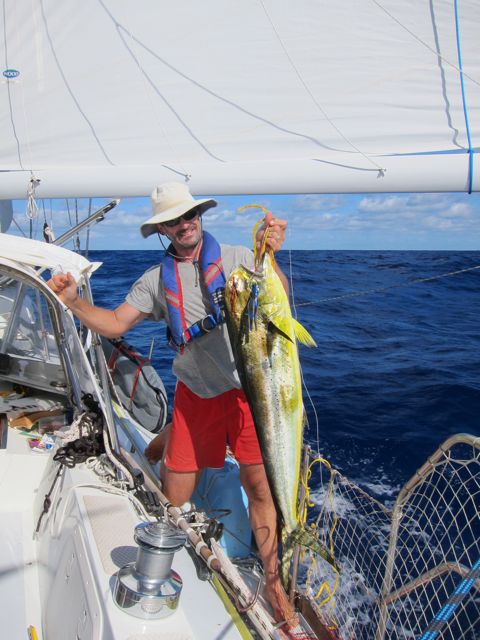
On the second half of our trip the mahi mahi drought finally ended - in a big way!  We ate a lot of mahi mahi.


That last fish was caught the day that we made it into Bundy.  By then, we had been sailing long enough that the beginning of the trip was already fading from memory.  Before the fact, I had confidently predicted a twelve-day passage.  Alisa was kind enough to only bring that up once or twice.  We still love long passages, we still felt the peace of being at sea, far from everyday cares.  But we missed the radar alarm on this one - would have been good to get some more sleep!


The end.

Wednesday, November 9, 2011

Futuna Is

Well, if you'll indulge me, I'll backtrack a bit to Futuna, which was the starting point of our 18-day sail to Bundaberg.

Futuna is...

...the kind of place where you go to check in with Customs, and come away with the lei that the Customs official had been wearing.  This has to sum up everything that I love about Polynesia - it's the place where strangers give you flowers.

Futuna was Alisa's very favorite stop on the whole crossing.  It's a little French dependency northeast of Fiji that gets only about 25 yachts a year, and almost no non-yacht tourists.  People were incredibly friendly and helpful and eager to interact with us.

By the time we reached Futuna we were starting to get a little dazed from all the travel we've crammed into the last six months, and our photography suffered from the travel fatigue.


 But I did get a pic of Elias in the back of a pickup on a hitchhiking foray around the island.  We're going so fast, he said.


Futuna is at 14° South, and I found the heat to be a bit insufferable - check out my sweat-soaked t-shirt.


Lucklily, we could swim off the boat every day.


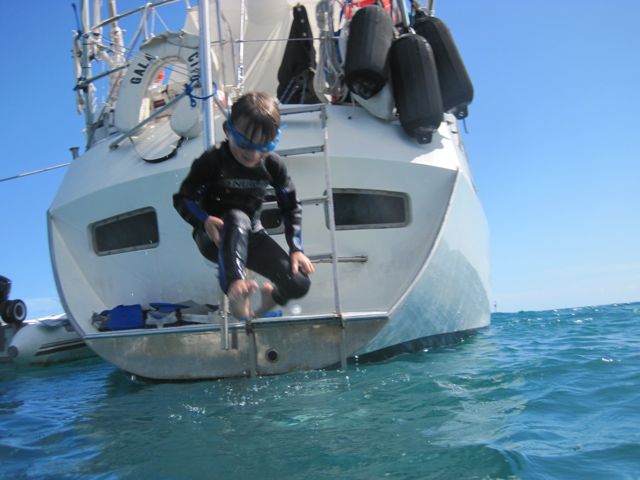
Elias discovered the joys of jumping off the jupe.


And, as always, we had lots of chores to attend to.


I hauled water.


And we made a new cage to keep the escape artist safely in his bunk at night.


We pulled the jib down on deck for a bit of sewing.


And Alisa did some laundry.

With all that to take care of, it's not surprising that I never got around to drinking kava with the men.

Hopefully we'll go back some day when we have a little more time...


The end.

Monday, November 7, 2011

Bang/Whimper

We're in Bundaberg, so this second Pacific crossing is officially a wrap.

The ending of the trip was a T.S. Eliot sort of affair - it ended with a bang and a whimper.

The bang was the sound of the main backwinding as we were running between the flashing red and green entrance markers for the Burnett River late last night.

The whimper was the sound that Alisa made after her hand ended up between the preventer and its cleat when the main backwinded, so that all of the load was taken by her hand.

After she got her hand out of the cleat, she couldn't move several fingers.  Her strained tendons were bulging against the underside of her fingers and the swelling was beginning.

After sailing all the way across the Pacific with really no mishap at all, our only sailing accident came literally in the last mile.

I think a big part of the blame goes to us making the entrance at 0230.  We were sleepy and much less organized about handling the boat than we normally are.

So Alisa went to the hospital and got x-rayed on her first day in Australia.  Nothing broken, but she still hurts and has restricted mobility.  We're hoping that time will be the cure.  Meanwhile, the only good bit was that it wasn't her dominant hand.

~~

We finally dropped the hook at 0300 and collapsed into bed.

The boys, considerately, woke up at 0450.

Elias started the day overjoyed at the prospect of being back in Oz.  Can I go up and look at Australia? were his first words of the day.

Things went downhill from there for him.  It turns out that his beloved headdress from Nuku Hiva - the one that Yolene gave him, and that he puts on whenever he feels like busting out a Marquesan pig dance - is made of banana leaves.  And nothing made of banana leaves is allowed into Australia.  So Quarantine confiscated it.

The little guy was heartbroken.  Alisa had him put it on to do one more pig dance before Quarantine took it away, but his heart just wasn't in it:


The Quarantine guys were very nice about it all, and were obviously wishing they just hadn't seen the thing.  Of course, after a run ashore on the marina lawn and an end-of-the-passage ice cream, Elias felt much better.

So, that was our first day back in Australia - I'm sure everything will look a bit better once we've caught up on our sleep!

Sunday, November 6, 2011

18

Tomorrow will be the 18th day since we last touched land, in Futuna. That makes this passage nearly as long as our two crossings to the Marquesas. The rowdy sailing at the start of the trip seems as far in the past as something that happened last year.

For the last day or two we've been daydreaming about the big lawn at the Port Bundaberg Marina, where the boys can run and run and run. And Alisa has been talking about the delights of the marina laundry room.

Everything going well, we should make it into Bundy tomorrow, though too late in the day to clear into the country.

Friday, November 4, 2011

Slow Good

We're sailing, but we're not getting anywhere.

We have the jib poled out to windward and the main prevented. The windvane, mysteriously, is managing to steer us in the three knots or so of wind that we've been averaging for the last day and more. I never see the wheel turning, but whenever I look up at the masthead wind indicator, it shows us on a broad reach on port tack. The catch is that the wind seems to be "blowing" in a grand circle, so a broad reach on port tack might see us sailing southeast, or north, or dead west, or anywhere in between.

The boat is not perfectly still, but we've been in many anchorages with more roll than what we're experiencing out here, 300 miles from the coast of Australia and in 2500 meters of water.

Alisa and I prefer sailing to motoring, but usually when our boat speed falls to two knots or so we give up and fire up the iron genny. But in this case motoring through the light stuff would just get us into Bundaberg over the weekend, where we'd be faced with overtime charges for clearing in. And there is that pesky coolant leak that keeps me from wanting to run the donk for too long. So we're drifting around on port tack, waiting for the winds to return.

Two nights ago, at three in the morning, Alisa had an epiphany about night watches - something like, why are we standing watch when we're not going anywhere and can barely keep our eyes open anyway? So we both slept through the rest of that night, and, except for a few wake-ups to look things over, the whole of last night as well. We're now 15 days out of Futuna, and, except for our night at anchor in Ouvea, we had stood a continuous watch throughout. Doing that and then keeping up with two under-exercised boys during the day was beginning to seriously frazzle the collective parental vibe. Catching up on sleep has given us a second life - everything looks fresh, and we find ourselves happy for no apparent reason.

The wind will come again, as will the busy shipping traffic on the east coast of Oz, so we'll have a few more sleep-deprived nights before we get in. But for now we're enjoying this interlude of all being together, in this very improbable spot, doing nothing much but enjoying the company of our family. It feels like we've re-discovered one of the joys of life under sail, the occasional interruption of plans and schedules while nothing much happens for a day or two. Given how frantic we've occasionally been in recent months as we worked to pull off our trans-Pacific delivery/cruise on such a tight schedule, this has been a treat we've been well primed to enjoy.

Wednesday, November 2, 2011

Westerlies

Hmmm, maybe those 800 miles from New Caledonia to Bundaberg aren't such an afterthought after all... We had westerly winds today, which kept us heeled over, "living on our ear", as the saying goes. Very inconvenient with the kids.

We reduced sail and steered a more northerly course to make the motion gentler for lunch time, and later in the afternoon did the same for a round of showers on deck for the whole crew. Poor Elias was the first one to get a bucket of sea water dumped over his head, and therefore was the unlucky soul to make the discovery that nearly 24° S and a stiff wind make for a frigid bucket shower experience. We all opted for the pre-heated freshwater shower after that.

Elias, by the way, got through the whole day today without throwing one tantrum - quite a milestone for the adults who are sharing the finite space of Galactic with him. He's been averaging two or three daily fits of screaming and crying lately, and Alisa has had to bolster my patience by reminding me of the other five-year-olds we know who still act that way. He doesn't complain about sailing long passages, but clearly he has far more energy than can be consumed in the confines of the boat, and doubtless that's part of the reason for all the histrionics lately.

One of the weather forecasts we've been looking at shows a big high pressure with absolutely no wind at all passing over us during the next 48 hours. Still 470 miles to go to Bundy at this point - looks like we might get part of the way by drifting.

Monday, October 31, 2011

Home Stretch

Well, we made it around the south end of New Caledonia last night, and then we were able to finally point the bow just south of west, straight at Bundaberg, our chosen port of entry for Oz. There is a certain amount of excitement on board - what a long way we've come since our first anchorage in Sausalito - and the 800 miles between New Cal and Bundy seem like almost an afterthought. Alisa canvassed the crew as to what sort of foods we were craving after our months of eating boat grub. She is looking forward to that first lamb burger. Elias wants a piece of ham. And I'm just craving some mahi mahi.

We had been hoping to reach Bundaberg in time to clear in on this coming Friday. But the sea, as always, is being free with the lesson of patience, and the winds have died to nearly nothing. Even if we were tempted to just motor through the calms, a coolant leak on the donk has announced itself as the latest entry on our endless list of things to fix, so we'll be traveling at whatever speeds the elements dictate.

And that's not so bad. Eric can run around in the saloon without us having to worry about him falling or puking, and he's much happier for the freedom. Alisa and I have a little more time to digest everything that's happened over the last six months, before we engage with the next phase of being back in Australia, and this whole crossing recedes into memory. And the Pacific is (at least for now) giving us a curtain call of how wonderful everything can be on a small-ish boat far out to sea, with the long swell from some storm far far away lulling us through the day, and the almost-tropical sun dappling the waves, and Eric picking the gibbous moon out of the daytime sky and exclaiming, just as his brother did, a few years ago from the cockpit of another boat on the other side of the Pacific, "muhhh!"

Friday, October 28, 2011

Pit Stop

Well, this has been the break we were dreaming of. Or would have been dreaming of, if we had been sleeping enough on passage to get a chance to dream! Ouvea is an uplifted atoll where we found a wide expanse of turquoise water, perfectly protected, to recover from the vicissitudes of sailing a thousand miles in six days with our two little kids.

After a round of naps we rigged up a buoy swing from the end of the boom and Elias and Alisa and I took turns launching ourselves into the water from the side deck. We remarked on how much cooler the water is here, at 20° S, than it was at 14° at Futuna. We tackled a few boat jobs, Alisa made pizza, and we showed Elias the baby sea snakes that were attracted to our deck lights at night. And then, in spite of our best intentions to get an early night, Alisa and I found ourselves going to bed at midnight.

This gave us six hours of uninterrupted sleep. I don't think I've felt so completely rested since I was a government employee...

The catch in all this is that stopping in Ouvea has left us with 150 mile of sailing to the SSE to get around New Caledonia - right into the prevailing winds. But, better than we could have hoped for, the weather forecast is promising light winds, from the east and even northeast, to get us around that obstacle.

When we were looking through our charts last night we found another chart of the Chesterfield Reefs, this one identifying them as a French possession. So we're not quite sure whose they are. Because a travelling yacht is one of the few places in the world that is still somewhat safe from the hazards of unlimited information on demand, we'll indulge ourselves in ignorance.

And, whether they're Australian or French, it doesn't really matter - it's now too late in the trip for us to enjoy any relaxing interludes in out-of-the-way places. The long-imagined end of the crossing is just over the horizon - we can smell the burning cane fields of Queensland, we can taste the meat pies from here. Today, some time before lunch, we'll pick the hook by hand and set off for Australia.

Wednesday, October 26, 2011

Change of Destination

The Australian sailor I spoke with about Chesterfield Reef while we were in the Marquesas seemed so knowledgeable about the place. A French patrol boat comes along every now and then and makes yachts that haven't cleared into New Cal leave, he said, but aside from that it's a pretty easy place to stop into.

With that info, and the rapturous reports we'd gotten from some friends who visited last year, the place had made it onto our short list of possible stops on this crossing.

But yesterday, when we were actually on the way there, I finally opened up our small-scale chart of the western South Pacific and saw Chesterfield Reefs identified as an Australian possession. We had already been talking about cancelling our stop there, as we are anticipating our landfall in Australia quite strongly at this point. But seeing the reefs identified as Australian made the decision final - the Australians patrol their outlying possessions energetically, and are very unforgiving about stops at any Australian territory before formal clearance has been granted at a port of entry.

So Chesterfield was out. But by yesterday our reserves were also running quite low. During long passages on Pelagic we used to both sleep at night while we trusted our radar alarm to warn us of nearby vessels. But a nagging sense that this isn't quite the thing to do, coupled with a very un-trustworthy radar unit on Galactic, has seen us taking turns standing watch through the night on most of this crossing. And now, on our sixth day out from Futuna, the four and a half hours of nightly slumber and long days of keeping up with the boys has us knackered. So we're planning on pulling into the atoll of Ouvea tomorrow for a good night's sleep.

Meanwhile, our rallying cry of "It's a delivery, not a cruise!" rang particularly true last night as we sailed right through the delightful archipelago of Vanuatu without stopping. We did the same thing last time around - we really do owe ourselves a stop there if we ever get to our third Pacific crossing.

And finally, the specter of a mahi mahi-less crossing is beginning to threaten. We caught a fish two days ago - yet another skipjack tuna, the only thing we've caught on the entire trip. Our fishing ethos doesn't extend to throwing less desirable fish back, so we ate it, and forewent fishing until it was consumed. And then at dinner tonight we suddenly heard the reel singing out and looked back to see a marlin leaping into the air over and over as it stripped off our line and got farther and farther away. It broke the leader, of course. So tomorrow, at least for the time we're not sleeping at anchor, the search for the elusive mahi mahi continues...

Sunday, October 23, 2011

Enhanced Trades

Into the Western tropical Pacific, and things are as they ever were.

Apparently the Pacific has shifted back into La Niña conditions. What do I know, I had thought we were entering a neutral ENSO state. We had La Niña conditions the last time we crossed, and among other things La Niña produces enhanced trade winds in the Pacific. So after our day of waiting for "better" weather at Alofi, we sailed out into a front and have been booming along with a double-reefed main for two days - 185 miles, noon to noon, the first day, and 180 the second. The steep cresting seas look just like our memories of the western Pacific from the decks of Pelagic. Eric has been confined to the cockpit by the rough weather, but has only been sick once. I have been laid out a bit as well, but without the interference of the seasickness medicine have rebounded quickly.

Spurred on by Elias' enthusiasm, we cooked up the flying fish that we found on deck this morning and had it for breakfast. Not bad.

The new fishing reel that we bought in American Samoa has sat idle on the stern rail. Alisa and I have our hands more than full and have little interest in dealing with a flopping tuna just now.

Thursday, October 20, 2011

Passage to Alofi

Last night, after the kids were asleep, we finally had Galactic ready to go. Half of the main anchor chain had been pulled by hand, the stern anchor had been pulled and put away, the sail cover was off, the awning was down, Smooches the inflatable was deflated and lashed into place, Little Dipper the hard dinghy was secured forward of the mast, water had been hauled from shore, the coconuts and bananas and diaper buckets and water jugs and solar shower were lashed on deck, the jib had been patched, rust spots on the hull given a little attention, the prop cleaned of barnacles, the zincs scrubbed off, ditto the rudder and waterline, the batteries checked, the rudder had been connected to the grounding system, the cracked bulkhead where the windvane lines attach had been strengthened, and a new lee cloth / sleeping cage had been installed for Eric.

Once the kids were asleep, and all this was ready, we agreed that we had no energy whatsoever left for sailing, and settled instead for a glass of white wine in the cockpit and an early night. I checked the weather before turning in and was interested to see a big zone of disturbance appearing in the 72 hour forecast, right in our path.

In the morning I checked the weather again. The front that has been propagating across the South Pacific was about 24 hours away from us. It would bring good sailing winds, but the updated forecast now showed disturbances behind the front both 48 and 72 hours out. So, in spite of the excitement that has been building over the idea of actually setting off on our last leg to Australia, we decided to just make the six-mile passage to Alofi, the other Island in the Iles de Horne group, where we could drop the pick in a more secure anchorage and give the weather a day or two to develop.

So that's what we did.

Alisa and I had each taken a quarter of a sturgeron, that wonder seasickness drug much favored by the in-the-know yachtie, before we checked the weather and decided to delay the start of our long trip. And that ended up providing me with a very informative unplanned experiment. The sturgeron made me feel awful. My eyeballs ached, my heart fluttered, and after we had moved to the new anchorage I spent most of the day napping. If we had been at sea I would have thought I was seasick, but in fact it was the seasickness medication that was causing it all. So no more of that stuff for me.

Aside from napping, we passed the day by swimming off the jupe with Elias, who executes a mean cannonball from the top of the swim ladder, and by filling the kiddie pool in the cockpit for Eric. (Futuna and Alofi have been desperately hot - I all too literally leave little pools of sweat everywhere that I go down below.) And we've watched the clouds building in the west as the front approaches. And now I'm going to check the weather again to see when we might get going.

If we're here another day the dinghy will have to go into the water - there is a sandy beach by the anchorage and a little village just inshore of the reef where nobody lives anymore, but that is visited daily by people from Futuna who keep gardens here. It all looks wonderful.

Sunday, October 16, 2011

Remembering Childbirth

We're in Futuna, this French bit of Samoa in the hinterlands of the central South Pacific.

The sail from American Samoa was only four hundred and thirty miles long or so, which we expected to do in three days, and nearly did, in spite of light wind. Beforehand we had looked at the trip as a gimme, a little doddle to go between the two one-week passages behind us and the two-weeker that we have coming up.

But...

First of all, Eric got sick sick sick the day after we left Pago Pago - vomit all over the starboard settee, then a repeat performance in the cockpit, and a seriously unhappy one-year-old throughout. We dosed him with benadryl and Alisa's milk and let him sleep it off in his carseat under the dodger. He was fine after that, but we were loath to take him below for fear of setting off another bout of seasickness, and there's nowhere in the cockpit that's safe for a little person as agile and devoid of rational thought as he is. So we were stuck holding a squirmy toddler on our laps for much of the rest of the trip.

Or, Alisa was stuck holding him, as the second thing that happened was that I got sick sick sick.

Really sick.

It wasn't seasickness, or wasn't ALL seasickness.

It was a little lumpy on our first night out, and I felt fine. But then somehow I just spiraled down and down the next day, so that I spent the afternoon catatonic in the cockpit, stirring only to be violently sick over the rail. (And I do mean violently. We had eaten gouda and crackers and papaya for lunch. Vomiting that through your nose involves sensations not easily forgotten.) After being useless for a few hours I made one final stab to contribute to the group effort when the main needed a reef. I got halfway through the job and then had to sprint to the rail to bring up, painfully, the very last luminous green liquid from my stomach. Alisa finished the reef on her own.

From that point on Alisa or Elias woke me up every five minutes to have a sip of water, and otherwise I was oblivious to anything that was happening around me.

I managed to stand two watches that night, although I'm not sure how. And the next day I was slowly better. The whole thing is mysterious to me, though I wonder if it was somehow triggered by being overtired and dehydrated through the push to get ready and get to sea. (And we started so well - we got 250 feet of chain and the 40 kilo anchor back from the dread depths of Pago Pago harbor in just an hour, even though we were pulling it by hand. No dragging anchor in our week there, and no junk on the anchor when we got it back. I'd rather be lucky than good.)

After I got better, there was still a day and a half left in the trip for Eric to officially, at the age of one year and five months, hit the Terrible Twos. It seems he no longer wanted to be in the childproofed area of the cabin where he has spent the last five months or so. And because he didn't want to be there, he just stood behind the baby gate and screamed and screamed. When that got boring, he switched gears and screamed while crying hysterically. I won't bore you with the details of how unpleasant it can be to share a small space with an overheated, cross one year old. I will tell you that it was bad enough that I got to the point of emphatically telling Alisa, several times, that I was going to have my eardrums prophylactically punctured once we got to Oz. Just so the screaming wouldn't hurt any more. Poor Elias didn't see me at my best for a day or two there.

All in all, it didn't stack up as our all-time greatest trip. And I haven't even gotten to the part where Eric climbed out of his crib and fell to the sole.

I measured - it's a four and a half foot fall.

Splat.

So that's a sound that Alisa and I will each remember for quite a while - the thud/splat that can only be your youngest child, who you thought was safely tucked in for his night's sleep, hitting the floor. Followed by a long long silence that blessedly turned out to be him drawing breath for an almighty scream.

He's fine.

But that's the second time he has gotten loose on the boat at the wrong time, the first being when he went walkabout in the cockpit while the other three of us were on the bow, picking up a mooring in Tahaa. Alisa and I are horrified that that sort of thing has happened twice, and determined not to push our luck for number three. As I write, she is constructing a new, maximum-security sleeping cage for his bunk...

So there have been any number of wonderful things that have come out of this year of travelling outrageously with our two young 'uns in tow. But lately it's been a little tough. The 'funny' part of course is that we've done it all before. I was struck, reading through the proofs for the book, at just how plain BAD were a lot of moments from our last Pacific crossing, when Elias was the toddler involved. I honestly had forgotten most of them until I re-read the book. For better or worse, we seem to treat sailing with little kids as I hear a person is meant to treat childbirth - by forgetting all about how bad it really was.

So on this last trip, we got to remember childbirth, in all its glory.

And I'm happy to report that after a couple days in the ridiculous little harbor at Futuna, we've pretty much forgotten again, and everyone is more-or-less happy.

<<The End>>

Tuesday, October 11, 2011

Pago Pago

It's funny - we spent a week in Penrhyn, and it seemed like a really timeless (though too short) part of our trip.  And now we've spent a week in American Samoa, and it's just seemed like an ordinary week.


Pago Pago Harbor is notorious among yachties for being filthy and a very difficult place to find a secure anchorage.  As often happens when our expectations are very low, we found things not to be all that bad.  The harbor is certainly dirty, but we were able to set our anchor on the first try, and the stay hasn't been bad from that perspective.  We've got our fingers crossed for the experience of pulling the anchor this afternoon.  Our biggest reason for coming here was to get the new windlass motor that the manufacturer in New Zealand swore would be here by October 4th.  When we arrived, all that was waiting for us was an email saying that the motor would take another two weeks to ship.  So we'll be pulling the hook by hand for the rest of the Pacific crossing.

We did get a couple of other parts sent to us, and we ran various errands to keep the boat going.

We heard a lot of horror stories about the water quality here, so we bought 150 gallons of purified water to fill our tanks.  It was the first time we've ever bought water.

We made a bus/taxi expedition to the local US-style warehouse store for a big resupply.


And we visited the local market almost every day.

Alisa and the boys ventured to church yesterday.  The first Sunday of every month is "White Sunday".


The one-time commercial fisherman in me loved checking out the tuna purse seiners in the harbor.  That's a helicopter on the wheelhouse of the closer one.

If you're used to Alaskan salmon seiners, the scale of these boats was pretty mindblowing.  Check out the size of the net on the back deck in this shot.

And well, that's all we have to report from American Samoa.  As always, getting things done for the boat while also caring for the kids has taken much longer than expected -  but we expect that now!  Assuming we can get the boat packed up today and the anchor retrieved, we're setting out for the French colony of Futuna this afternoon.  More from there!