Showing posts with label Caribbean. Show all posts

Friday, March 10, 2017

What I Like

That's what I like. Galactic is just to the right of the guard tower
Panama, rather than being the between-the-oceans transit lounge that I was expecting, has turned out to be a fantastic destination on its own terms, regardless of our business with the Canal.

A highlight for our crew of wandering biologists has been the biodiversity. More bird species have been recorded in this little country than have been recorded in all of the US and Canada combined.

As for the people part of travel...I find that I am getting to be more and more like our friend Richard, on the indefatigable yacht Thélème, whom we met all these years ago. Richard, who has been sailing much longer than we have, once explained to me that he has reached the point where, if given the choice between two anchorages, one in front of a village and another off by itself, he inevitably finds himself gravitating towards the lonely anchorage.

Portobelo and the lay of the land
And so it has become with me. As a case in point, I offer up the delightful Caribbean port of Portobelo.

The place is filthy with history. Sir Francis Drake was reportedly buried at sea just off the harbor, and the history only ramps up from there.

Portobelo today is a fairly quiet roadside town, come down quite a long ways from the years, centuries ago, when it was a terminus for the transshipment of the fruits of genocide.

The town is something of a backpacker destination, and has a very lively Carnival scene infused by the local Afro-Caribbean culture. There are two Spanish forts, long since abandoned, right in the town, and all sorts of little eateries for bored looking tourists.

And, from day one when we made our immigration formalities there, I would have happily not set foot in Portobelo the town ever again.

The other side
But the other side of the harbor, away from the town, was my very image of travel idyll.

Here it was possible to anchor just off of another derelict fort, this one a three-level affair with a large waterfront fort, a smaller one a hundred meters or so up the hill, and a third at the top of a short track through the jungle.

Ba-boom
 The area around the two lower forts has been cleared of trees, producing a wonderful forest-grassland ecotone that was a birder's dream. It was always possible at the end of a day of science work to nip over with a boy or two and spot a handful of new species.

And when there were other kids about for the junior Galactics to play with we would send the whole mob ashore to go nuts in the forts without the inconvenience of adults sticking up the works.

Just look at the top picture in this post - can you imagine a better setting for the 6 to 10 set to be left to their own devices?


Our great friend Diana gently, and rightly, pointed out to me that my recent anti-rally screed sounded suspiciously like the ravings of a grumpy old fart.

(But, Diana, they're doing it right now! The "Puddle Jump" rally is having a meeting today in Panama City. When did anyone ever dream of going to sea so that they could attend meetings? And now they'll go to this meeting, and then they'll hurry through the Tuamotus so they can make it to the staged cultural event in Moorea, all the while ensuring that they travel half the world round without leaving the bubble of people very much like themselves.)

So yes, you're right, Diana. Grumpy old fart status attained.

And so it is, perhaps, with the people side of travel.

I still love meeting people, and various yachties remain some of the most remarkable people I have ever met. And at times in the past we have gone to great lengths to achieve friendship across cultural and linguistic barriers, with extraordinarily wonderful results.

But our affairs with town life in a place like Panama can be fairly transactional, and the trouble of getting past my awful Spanish to make a meaningful connection with a local can seem like more trouble than it is worth.

In contrast, a place like that abandoned fort on the other side of the harbor from Portobelo, redolent with history, offering reasonable solitude, and the delight of learning a new place through its avifauna...put me in a place like for a couple of hours with my family, and I am completely content with life.


Monday, March 6, 2017

Status

When I'm back in the Lower 48 USA version of land life, one of the things that I immediately notice is how desperately important status is.

People drive around in Mercedes cars or BMWs and the whole point seems to be having that very expensive hood ornament that you can push into other people's faces.

How silly! Who would dedicate their lives to earning enough money to guarantee an existence of brand fulfillment?

But, then, on further reflection, I begin to see the point. Status is incredibly valuable. Put in the plainest terms, if you have status, you live longer. (Read about the Whitehall Study. It's fascinating.)

So if status grants you a longer life (and all sorts of other benefits in terms of happiness and access to high-quality mates and so on and so on) then of course people will go to great lengths to pursue it. And a BMW badge on the hood of your car is what evolutionary biologists would call an honest signal of quality. You can't just gin up a luxury car in your garage. You have to buy one, and they cost a lot, and so having one is a difficult-to-fake signal of your status in the society.

Not that dedicating your life to earning enough money to drive a fancy car isn't an ugly trap. But there is an unarguable logic to the trap.

And all this has anything to do with sailing....how?

Motoring towards the Caribbean side of the Canal. A vast field of anchored shipping, all waiting to get through
There was this funny dynamic that we noticed in the Caribbean.

Suddenly, we were cool.

Yachties when meeting each other almost never ask the normal first question of land life - What do you (or did you) do for a living?

That would be grotesquely poor manners in the life afloat. Plus the answer would usually be too dull for words, anyway.

But yacthies meeting each other do typically ask about each other's program. Where have you been? Where are you bound?

A lot of sailors in the Caribbean are just starting out. So when we tell people about where we've been, we find ourselves suddenly rocketing to the head of the sailing hierarchy.

Both in the Alaska work boat world, and among the highly-accomplished sailors whom it has been our pleasure to get to know since we left Alaska, we've noticed that there is a strong correlation between ability and humility. The most accomplished people don't have to spend time letting you know how good they are.

I hope that we follow that example and don't spend much time trumpeting our accomplishments. But for all that, Alisa and I both noticed how...good...it felt to be held in esteem by new acquaintances. We had a version of social status that we were unused to. And it was a very pleasant elixir. I wonder if we weren't just noticing the feeling of our blood pressure going down.

Whether or no, I think that's all over now that we're on the Pacific side. Most of the boats here are about to jump off on very large trips indeed, on some of the greatest adventures that it is possible to have on your own boat. And we are, once again, just another boat in the pack.

Which is fine with us, of course. We'll fall back on that Hiscockian thing of leading a life that has you thinking well of yourself, rather than measuring yourself through other people's opinions.

An early touchstone of commonality between our line handler Denise and the Galactics - Denise likes Tin Tin, too!


Tuesday, February 21, 2017

The End


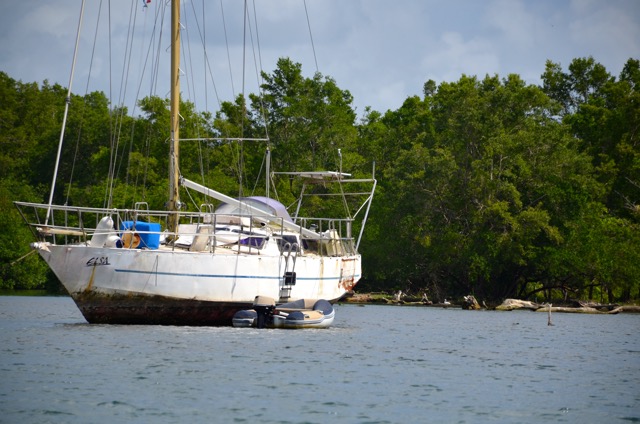
I took a photo tour of the wrecks of Portobelo yesterday.

This sleepy anchorage took a heavy hit from Hurricane Otto last November.

Until Otto, Panama was considered completely safe from hurricanes.

Otto came ashore on the border of Coast Rica and Nicaragua, and it is the first hurricane to make landfall in Costa Rica since reliable records began, I believe around 1851.

It formed later in the season than any other major hurricane during the satellite era.

Given that Panama was considered to be well outside the hurricane zone, boats here would have been completely unprepared to ride out a really big blow. In Portobelo, eighteen or so yachts (I hear different numbers) ended up on the beach.

As you can see, quite a few were not salvaged.

A very informal survey of the wrecks suggests that metal boats are much more likely to still be in one piece, even if they have not been refloated. The glass boats are open to the tide, or resting on the bottom.

So, this was the end for a number of dreams, the sudden culmination of all the resources and effort that people expended to go to sea in their own boats. No sailor can look on these scenes with equanimity.

As you can see from the dinghy by the boat that is aground on an even keel, people appear to still be living on at least a couple of these boats.

The boat with the sails up, right in front of town, really caught our eye. Doveilyn, or Dorcilyn, I can't quite read the script on the hull. She appears to be a really nice little boat, and when we were first in Portobelo someone was still at work, apparently trying to refloat her.

But when we returned to Portobelo after being away for more than a month, she was abandoned with the sails up, in the same place where we had last seen her.

Finally, I think this is a really informative example of how a changing climate can catch people out. There is an incremental trend - Otto only came ashore 50 or 55 km farther south than the previous most southerly hurricane to make landfall in the Caribbean. But a very sudden, very abrupt event is embedded in that trend. If you're sitting in a crowded anchorage on the day that the definition of hurricane-safe areas changes, you get a lifetime of climate change impacts at once.

And I should close by noting that in addition to these wrecks and property damage ashore, 23 people died in Panama, Costa Rica and Nicaragua during the storm...

Monday, February 20, 2017

The Kuna and the Snail

Yet another moment to remember when we're back in Alaska
The San Blas are an autonomous island group, nominally a part of Panama, that are the home of the Kuna Indians.

Isla Tiadup, San Blas
The San Blas are one of the marquee destinations in the world "cruising" scene. We have met very experienced yachties who compare the place favorably to the South Pacific, we know people who have spent months and months there on their boats, over multiple seasons.

El Caracol
We arrived in the San Blas  after our rollicking sail from Cuba. And the first thing we did was to reconnect with our friends on El Caracol, a Portuguese family whom the other Galactics had gotten to know in Curaçao last year while I was away in the US for my science work.
Galactic and El Caracol in the background, and the ships' people taking the waters
My immediate impression of the San Blas themselves was a little...blah. The anchorages were packed with yachts, many of them in the charter business, carrying cargoes of backpackers from island to island. Not so tranquilo.

Jorge and the Galactic dudes, post-spearfishing mission
Los Caracoles, though, proved to be a ton of fun. (El Caracol is "the snail" in English, of course. They have a blog, with out-of-this-world photography, at entretantoabordo.com.)

Here and below - Kuna garb

The progress of global cultural homogenization, written in the dress of three generations of Kuna
So we naturally fell into hanging out with El Caracol, and didn't engage with the San Blas, or the Kuna, much at all.

We bought a few of requisite molas, the traditional appliqué that adorns pillows in many a yacht we have been aboard.

The second anchorage that we visited with El Caracol was an informal Kuna resort of sorts, with accomodation provided for the backpackers who were sunning themselves on the beach.

People took selfies, and uploaded them to Facebook.

El Caracol was off to Colon to be measured for the Canal. They had heard rumors that in either February or March, they forgot which, the number of yachts seeking to transit would make it impossible to book the canal without an agent.

(There is a pronounced negativity trap in the western Caribbbean. More about that in a future post.)

Our minds were already on the blessed Pacific, our home ocean, and at this point, as much our home as any place on shore. More so.

After only five days, we decided to leave the San Blas and go look into our own arrangements for the Canal.

The San Blas clearly has enough admirers already, and we were happy enough not to add ourselves to the list.


Tuesday, February 14, 2017

No Style

Alisa, waiting out a rain squall
Well, that's what you get when you get up on your hind legs and pontificate about what does and does not count as proper style, sailing-wise.

Or, as Alisa put it, "We chose this weather?"

The plan was to get to Bocas del Toro, about 150 miles away to the west of us, close to the border with Costa Rica. We could spend a week or two based there, and with any luck get up to the mountains at Boquete, and then make it back to Colon for our date with the Canal.

What could be simpler?

And, the weather forecast showed that we would get the last good sailing conditions before a prolonged spell of calm settled in. Of course, we would get caught by a front before we got there, and then would face 10 knot headwinds for the last 30 miles or so, but hey! We're Cape Horners and stuff. We're allowed to spit to windward! Not a problem.

So we set out in the morning, all fired up for an overnight sail and the promise of some natural history delights in a new corner of Panama.

The sail started off as a ripper. Eight knots, and not even trying.

We passed through the ship anchorage off Colon in the daylight, just as neat as could be.

And then, in the middle of the night, we got caught by the front.

I was awoken by an awful commotion on deck and stuck my head through the companionway to see Alisa in the act of being bedrenched by the mother of all tropical downpours, trying desperately to furl the jib, which was making a sound like coconuts hitting a sheet of galvanized tin.

Recognizing the better part of valor when I saw it, I limited my assistance to tailing the furling line from the shelter of the dodger and making encouraging remarks about how she could handle the situation better next time.

After the jib was furled and Alisa toweled off, it somehow transpired that it was my turn to go on watch.

The hours between 0200 and 0600 passed in the most perplexing sailing that I can remember. No matter what I did, I couldn't seem to tack the barky through less than 170 degrees.

The wind was blowing about 20, dead from Bocas del Toro towards us. I had her reefed down, and first I sailed due north, and then I came about and sailed due south. The wind shifted, I reacted. It rained, I hid under the dodger.

And as the hours passed, we got exactly no closer to our destination. In addition to the wind, it was obvious that we were bucking a pretty serious current.

When Alisa awoke and the light of day was on us, I gave up and fired up the donk.

I gave her revs, I strapped in the reefed main, I boldly pointed the bow more or less where we wanted to go, and...

...same thing. First we went due north, then due south. And to the west we went not at all.

By noon, our patience was nil. The engine had been going at hard revs for hours. The forecast showed the same front sitting over us for the next day. And we were still working hard to get exactly nowhere.

And so, with enough angst and gnashing of the teeth on my part that I would blush to tell you about it, we made the decision to turn around and head back to Portobelo, from whence we had come.

For the first three hours we flew. Eight knots, not even trying.

And then we ran out of wind. And we were given the most arresting show of strange wave morphology, as the two opposing swells met each other and sent fountains of water shooting straight up into the air. It was a great illustration of just what a powerful swirl of current we had managed to land ourselves in.

And then, the wind came up, and we sailed back...straight into headwinds for the last 80 miles or so.

After about 46 hours under weigh, we dropped the anchor right back in the same full-ish harbor that I had been so eager to leave behind.

In retrospect, we obviously forget a long-ago learned lesson about how poorly the forecast models capture fronts, and how easily they can give you 20 knot headwinds instead of 10.

And, we forgot the advice of friends who had done the same trip a week or so earlier, and warned us about how hard the adverse current had made the trip, even though they had no wind at all.

But, more than anything else, it was yet another reminder of how humbling it can be, trying to get yourself from one place to another on a boat, even in the very benign arena of the tropics.

There are times in this life afloat when questions of "style" don't seem so immediate, and your only concern is to do what you set out to do without making a complete mess of things.

On the bright side, the tooth fairy managed to find us on the first night out, even with all the pointless sailing around that we were doing.

And this Portobelo that I had been so happy to leave behind...it doesn't look so bad now, at all.


Thursday, January 19, 2017

No Dust On Us

Entering Colon harbor at dawn

This much shipping traffic - our AIS screen. Drift to the wrong side of the channel and harbor control is going to let you know about it.
Roberto the Panama Canal admeasurer. Eric got to help measure the Mothership
I got to help with paperwork
We're thinking in big chunks of ocean on board Galactic.

South Africa-Cuba. Panamá-Galápagos-Hawai'i.

And so on, to the logical end.

But sometimes to make a big chunk of ocean go by under your keel, you have to get through a little hoop first. Like, for instance, the Panama Canal.

Alisa and I both get instinctively nervous when the movements of the barky are constrained by forces outside our own control.

So when friends shared the news that booking a slot to transit the Canal might get difficult during the peak months of February and March, we saw a problem that needed to be gotten after, quick-like.

We hope/plan/intend to cross to the Pacific side in February, after I return from a fortnight of work in the Great Land and one of those Lesser United States. Like everyone else we know who is transiting the Canal this season, we're making our own arrangements, without using an agent. So, in order to book a slot, we had to clear in to Panama (that doesn't happen when you arrive in the San Blas), get ourselves to Colon to get the boat measured, and then pay our fees.

So it's been a hectic week so far. Ripper sail to the Port of Entry Sunday, on Monday talked the Port official down from a $20 bribe request to $10 to check us in (Where was the steely, "we don't pay bribes" spine of Carolyn Goodlander when I needed it? The official just said to me, "That's fine. Go ahead and check in at Colon then"), caught a ride from friends to the fantastic town of Portobelo to make our peace with Migración and get SIM cards the same day, made our appointment for the admeasurer Tuesday, then journeyed to Colon (where we do not care to anchor) and back today (Wednesday) to get into the Canal system.

Whew. This carefree wanderin' life can be a rush when you're trying to get someplace.

But we feel like we've gotten away with something to get Galactic measured before I jet to Alaska on Sunday.

And meanwhile, we've been having plenty of fun in Panama in our spare time. The birds! The ruins! The Snails!

More soon...


Thursday, December 8, 2016

Guantanamera...

...guajira Guantanamera.

If you know the lyrics you can hear them as you read them from your screen.

Is there a more swinging melody out there?

The more hip among you will also grasp the connection to José Marti, Cuban hero.

So, this is clearly a lead-in to something...


We have tried to concentrate on the beauty of straight lines, but we have failed.

Particularly when it became clear that the land ahead of us, Colombia, was a land of marinas where visiting yachts were concerned.

I'd love to spend some time in Colombia. But if we're going to have to stay in a marina anyway, and this is our one-and-only (please, god) visit to the Caribbean, then maybe we should go stay in a marina in Cuba instead.

So! I overcame my severe allergy to authority long enough to ask the US Coast Guard, "Mother, may we?" in my sweetest voice. And today we got the answer (above).

So as soon as I finish off these damn research proposals (may they go forth and be fruitful) and finish a few pressing boat jobs (some things never change), we're gonna catch the first thing smokin'.

And we're going north, not west.

Guantanamera, guajira Guantanamera...

Tuesday, December 6, 2016

Out Of Touch

Yachts to the left of us... 
...and yachts to the right of us.
So, we're here in Bonaire, one of a long line of yachts moored off the main (only?) town.

The land is - just there - right over our bow. Close enough that I can easily hear the excellent live music being played on the weekends.

Elias and mate, off for a snorkel
But even though we are only 150 meters or so from land, it's now more than a week since I set foot in the dirt. And that last foray was just a quick dash to illicitly stuff a bag of our trash into a dumpster.

My last real land experience, a classic sailor's afternoon of cruising various shops for things that might be persuaded to work as boat parts, was ten days or so ago.

I find that I'm liking this all-aquatic existence.

Bonaire is a perfect place to get your exercise in the water. Every day I swim, usually for an hour or so, down the row of yachts and back.

The boys take recess from school every morning by jumping off the boat into the water about a hundred times in a row. I take a break from my research grant proposal writing and join them.

We pretty regularly take Galactic to one of the dive moorings around the island for a session of family snorkeling.

Elias is learning to scuba dive. Eric has suddenly gone from being a very poor, very reluctant swimmer to being one of those half-fish/half-boy creatures that you see growing up on traveling sailboats. And today Elias and his 8-year-old mate from Jadean took our inflatable, Smooches, and went off on an adult-free snorkeling safari.

True, it came to a premature end because Elias cannot always get the outboard started. But I love to see him and other kids off doing stuff on their own.

So for now, as I toil away at the science salt mines, and we occasionally grumble about the Caribbean, and how it's nothing like our beloved Pacific, we look up and realize that we've got about the best thing going that we could wish for.

An evening swim. Eric is still light enough to bodily throw off the boat. 

Why do they make kids' drawstrings so long, anyway?

Sunday, November 27, 2016

The Beauty of Straight Lines

I know that Twice in a Lifetime readers are geographically switched on. But just for some perspective...

In another lifetime, one that does not involve me working in marine science while we're also traveling the world, Galactic would be sitting in some anchorage in Cuba, and we would be wrapping our heads around the strange travelers' luck that saw us in that nation on the day that Fidel Castro died.

However, we do find ourselves in this particular everyday (and increasingly interesting) world of ours. And I do pour a tonne of effort into trying to "make discoveries, and share them with others", as E.O. Wilson so winningly defined the job of a scientist.

So, after our cracker of a sailing year, which began in the Falklands and saw us cross the Atlantic twice and finally visit South Georgia after years and years of thinking about it, it has been time for me to tend my discovery garden. I have been lucky enough to be funded to work on a long-standing pet idea of mine with an excellent group of collaborators who know much more than I do about all sorts of things about how the ocean works.

And while I'm very grateful that this work got funded, it means...doing a lot of work. And then there is the scientist's lot of continually looking for more funding, and a second project that is just getting off the ground...and, well. I'm becoming afraid that our boys' most enduring memory of sailing with dad will be me, sitting at the chart table with ear plugs in, looking at the laptop with a face suggesting that I'm in the final round of the World Grumpy Stare-Down competition.

All of which is the lead-in to say that Alisa and I, very far into the first decade of our life afloat, are waking up to the joys of straight-line travel. Cuba would have been...a big detour. And as worthwhile as it would have been (had we the time, and were my work not so internet-dependent), we are happy for once to just travel from point A to point B. Which in this case, means going from Curaçao to Panama via Colombia.

With one brief detour. We could not resist the temptation for a little backtrack from Curaçao to Bonaire to make up for the family snorkeling deficit that has been building ever since we sailed to Patagonia.

So here we are now, and we had a fine day of seeing the underwater sights today.

But...Bonaire.

I imagine it's a wonderful place to live, and I will plead guilty to having seen very little of the place, but...what a distressingly boring destination for a visit.

We're having fun and all, and I know we've only scratched the surface of the Caribbean. But it's hard to escape the idea that this entire sea exists only to remind sailors of how great the Pacific really is.

We're going through one of those periods when we don't take many photos. Here's one of Willemstad, in Curaçao. The brightly-painted buildings are meant to be iconic in some way...

Willemstad does have an excellent slavery museum, which A. and the boys visited while I was away in the States.

Monday, November 14, 2016

The Way Forward

Well, I'm back to the boat.

And what a visit to the home country that turned out to be!

The only good part of being in the US when the White Power candidate was elected to the highest office of the land was that on election night I happened to be in the company of the best man from my wedding. He and I went out and got drunk, both thoroughly and publicly.

It didn't make me feel any better, really.

So that hopeful feeling about returning to the home country? That has been replaced by something much more wary.

We do all have Australian passports, of course. And a boat that experience tells us is probably adequate to the task of sailing back to Hobart.

I remember going through the "we're outta here" phase on election night. I think it was mostly between drinks number six and nine. I found myself declaiming, to anyone who would listen, "I hope that works out for all y'all!"

But the draw of Alaska is strong.  There is also the thing about not wanting to be driven out of your country, but I find that consideration works on me only when Alaska is part of the equation. Without the Great Land, I think I'd prefer to go and be middle class in Oz, thanks much.

So, when we exit the Panama Canal early next year (everything going to plan), we expect to turn right for Hawai'i, rather than left for Fatu Hiva. Unless the Pussy Grabber In Chief has managed to start a particularly egregious war in the first couple months of his administration.

The year so far, as seen by the Caribbean Safety and Security Net
So. That leaves us in the Caribbean for a couple more months. It seems like a pretty trivial concern at this point, but we have so far completely failed to see the magic of the Caribbean. Our loathing for crowds and very low tolerance for crime risk are a tough combo here. See the map of reported thefts, assaults, and general non-fun sailor moments above.

We had thought about heading up to Cuba, but a chance comment from some Canadian friends about how Cuba wasn't such a fascination for them as it was for American sailors resonated with me. I had a visit to Cuba with that same best man about 19 years ago, and it was great. I don't think I really need to go again.

We thought about Guatemala as well, but very little research told us that it was the kind of place where sailors lock themselves into their boats at night behind stainless steel bars. Not the Galactic way, that.

So for now it looks like we're bound for Colombia.

Stay tuned.