April 15, 2008
6° 18′ S, 137° 19′ W
Day 20
“I wonder when we’ll be in the Northern Hemisphere again,” says Alisa. Emigration is such a big part of this trip. We are sailing to reach Australia, and some sort of new life there, the misty contours of which are suddenly much discussed. We aren’t those who wander and yet are not lost, we are those who are changing horses, and nations, in mid stream. Now that we are in the South Pacific, Australia is real, immediate, although months away. Brisbane, our likely landfall in Oz, is currently 4140 miles away, according to the GPS.
When ships and boats cross the equator at sea, King Neptune comes aboard to initiate first-time crossers. Since we lacked a shellback to act the part, Elias stood in. He decreed that the two initiates on board should each swim one lap around the boat. He was particularly hard on the captain, as befits a long-recognized moment when the hierarchies of life afloat may be reversed, and decreed a shaving of the head and a close trim to the locks. Tots of seven-year old Cuban rum were drunk, and King Neptune’s dram was poured overboard for his enjoyment. And then we sailed on, all three of us now confirmed shellbacks, Elias reaching this status at an astonishingly tender age.
The change from north to south was accompanied by a gratifyingly immediate change in our environment. The first night in the ITCZ was the only night when we had any inclement weather, but light winds plagued us for days. We motored due south to try to reach the southeast trades as quickly as possible. When the wind did come up it was from some direction between due east and due south and we sailed southwest under main and spinnaker. Pelagic won us over once again with her ability to make four knots in only six or seven knots of wind in spite of the huge cruising payload that we have crammed into every available storage space on board.
The skies were always blue to the south and cloudy behind us, but we could never quite make it to the new weather. A current of a knot and more was working against us. We motored through the night that brought us across the line, with the RPMs bumped up to 2300 to keep our speed above five knots.
After our line-crossing ceremony we fired up the engine and promptly ran out of fuel, the increased RPMs having made short work of the last 15 gallons in the main tank. I transferred the ten gallons that we carry on deck into the tank. We figured that we could motor for seven and a half more hours, and then we’d have to stop in order to have five gallons in reserve for motoring into our first anchorage in the Marquesas.
We motored for five hours, then shut it down to check into the two ham nets that we participate in. After the nets were done and Elias was asleep, Alisa and I held council. The wind was blowing a staggeringly insufficient four to five knots. We had two hours and change of fuel left to use on the passage. Should we use it now, and gamble that ten miles of southing would get us to the southeast trades, or should we sail southwest on this little breeze that would barely move us, and keep a little fuel in reserve? Even though the sun was down, sweat was running freely down my face as we sat in the salon talking. It was too sunny in the day to be in the cockpit, and too hot down below both day and night. Boats as much as a hundred miles south of us were reporting insubstantial winds on the nets. We had dodged the bad weather of the ITCZ, but we might be in for just a little grief from the doldrums.
We decided to sail. I put up the spinnaker and main. At first we were just moving at a knot or two. But in an hour the wind came up to ten knots, and then twelve, and it never left us again all the way to the Marquesas.
The southeast trades turned out to be what we had in mind when we thought of tradewind sailing. The swell was gentle, the wind was behind us, sea and sky were flawless blue. Sapphire blue. We moved along effortlessly, flying the spinnaker when the wind was light and jib and staysail when it came up to fifteen knots. We finally had current with us, and started to record ridiculously good 24 hour runs: 140, 150, even 160 miles. And it was brutally, blisteringly, despotically hot. We huddled in the shade of the dodger when we ventured out into the cockpit, and kept Elias down below for days at a time because the sun was just too much. When the wind came forward of the beam and freshened to sixteen knots or so we closed all of the hatches and portlights against spray. Then we actually began to suffer from the heat. We were always covered by a film of sweat, awake and asleep.
The child-rearing book encourages us to let Elias run around without a diaper as a step towards that dreamed of state, toilet-trainedness. Today I look down from the cockpit to see him starkers in the cabin, running circles in complete glee. A half hour later Alisa calls up, “Uh, Mike, I need your help.” She speaks the sentence slowly, as if willing herself to put together the words for effective communication at the same time that her brain is struggling to make sense of the sight before her. When I come downstairs she is leaning into the head and holding Elias by both arms. I peek through the door and see that he is surrounded by the wreckage of a bowel movement that, in its scale and narrative complexity, can only be called Homeric.
“I can’t believe that just happened,” says Alisa.
“I know what we’re doing for the next hour,” I say.
“Poop!” says Elias.


 during,
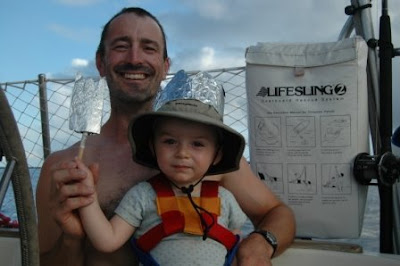 and after. Note King Neptune's crown and trident, univerally recognized emblems of his office.
 Alisa baked bread every other day.
 Working the barky.
 One that didn't get away.
 Our first sight of land, the island of Ua Huka. It's at the center of the picture, underneath the squall clouds that intensified after sunset and turned into...
 ...the worst weather of the passage.
 Sunrise was very welcome the next morning,
 Once the sun was up the weather moderated.
 Sailing into Taiohae Bay.
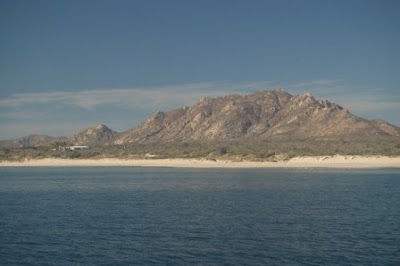 And finally, this was the scene in Los Frailes, Baja California Sur, our last anchorage before the passage...
 ...and this is Taiohae Bay, Nuku Hiva. Twenty one days at sea really did get us somewhere different.
 during,
 and after. Note King Neptune's crown and trident, univerally recognized emblems of his office.
 Alisa baked bread every other day.
 Working the barky.
 One that didn't get away.
 Our first sight of land, the island of Ua Huka. It's at the center of the picture, underneath the squall clouds that intensified after sunset and turned into...
 ...the worst weather of the passage.
 Sunrise was very welcome the next morning,
 Once the sun was up the weather moderated.
 Sailing into Taiohae Bay.
 And finally, this was the scene in Los Frailes, Baja California Sur, our last anchorage before the passage...
 ...and this is Taiohae Bay, Nuku Hiva. Twenty one days at sea really did get us somewhere different.


