Sunday, August 17, 2014

Still Makemo

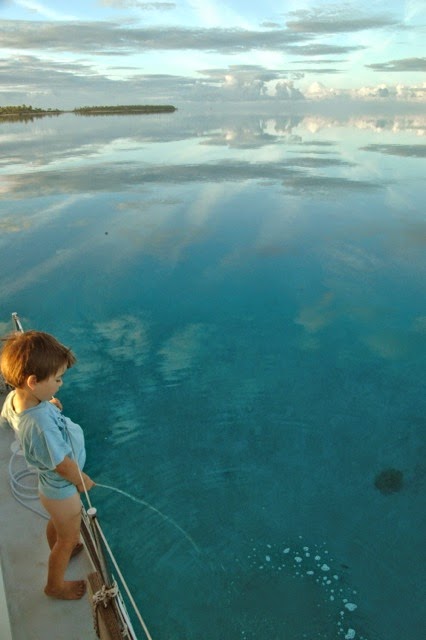
At Makemo, we experienced dead calm conditions - all through the night and into the dawn. 


By day the lagoon was infinite - our sight stretched out to the far flat horizon, and then bounced back to us.  At night the stars and clouds chased each other in the lagoon's embrace.  


What a four-year-old thinks about it all:


We sailed into the west pass of Makemo a couple days earlier with bad light for seeing coral.  It was an easy overnight sail from Fakarava.  The crew was anxious to see what we would find in this new place.


Or not quite new, as Makemo was the first atoll we ever visited, six years ago.  We remembered the anchorage off an uninhabited motu as a likely spot for celebrating Elias' 8th birthday.


Which we did.
 Birthday lunch - bacon and eggs.
When buying birthday presents, we're sure of our audience.

The birthday beach barbecue was, unfortunately, rained out.

~~

So, Elias' birthday was only ten days ago as I write this.  And it seems a lifetime ago.  We're now two anchorages, two passes, two nights of sailing, and one atoll further down the line.  We've made quick friendships, and said goodbye to new friends with some unaccustomed drama.  We've dealt with a dozen situations of mutual incomprehension and wondered how we might fit in for a while in a place where we've never been before.

As always when the sailing/traveling is this good, internet access is not up to the task of keeping current on it all.

More soon.

Saturday, August 9, 2014

Contingent and Bohemian

If you're paying any attention you'll know that one of my very favorite things about French Polynesia is how the internet access completely sucks.

Here in the village of Pouheva, on Makemo Atoll, the internet surpassed all our expectations for glacial service at a caviar price.  Here it just didn't work, period.

Which, since I didn't have any pressing work commitments that I was trying to meet, was completely fine with me.  I could live my life instead of staring at a screen.

Now, after a couple days, the internet is inexplicably working.  I met a couple of non-pressing work deadlines.  And then, as is my wont, I took a look at the Times online.

And, oh vey, is the world doing an awful job of looking after itself while we're on this endless voyage of ours.

At the risk of being facile, I cannot help but ask why we, and our boys, are living such a charmed life.  Why are we so endlessly fortunate?  Those four (?) young boys who were killed while playing on the beach in Gaza a few weeks ago serve as a counter-example to our experience that will stay with me for a very long time.
One of the natural history marvels of the South Pacific are nesting fairy terns.  They famously don't actually build a nest, but just lay an egg on a bare tree branch and let the newly-hatched chick balance as best it can.  We've seen lots of fairy terns, but never a nest - until we spied this one in front of the Rotoava Mairie - the town hall.  Chick and adult were active when we spied them at dusk, but when we came back for pictures the next day it was siesta time.  That fluffball on the right is the snoozing chick
Tuhoe, the mayor of the commune that includes Fakarava.  As an orphaned teenager, he was adopted by an Alaskan couple visiting on their yacht, and spent the next five years living in Anchorage.  I asked him to pose with the fish he was giving us from his freezer
So, there is no way to segue out of that sort of intro, except to say that we are (touch wood yet again) on the most amazing roll.  It feels like the first seven years of all this nautical carrying-on were just the warm up.  We are now securely living an existence more contingent and bohemian than that led by anyone else we know - with the exception of a dozen or so of our sailing friends.  Well aware of how swiftly the unyielding twists of lifetime narrative can put an end to this sort of idyll, I am treasuring every day.

Like…the day that saw us done with our various business at the big smoke of Rotoava, and sailing off to the south pass of Fakarava:


Here and below - the blokes, more or less keeping watch for coral bommies.


God, do I love sailing in an atoll lagoon.  As long as the light is good.


And me, at the end of our second three-hour day of sailing inside the lagoon.  Moving the boat takes it out of you.


 And this one, for our friends on Enki, who are sailing the populous waters of the Med.  Check out the egregious overcrowding in the south Fakarava anchorage - ten boats in one frame!

The good old days, they're all gone.


The main attraction that brings all these boats is the famous south pass, with its various fauna Chondricthian.  We of course wanted to see for ourselves.  This, and below, is what happens when Alisa tells four-year-old Eric to hold on in the dinghy on the way to the pass.

He flies instead.


And some of the goods: a Napolean wrasse, of which there were several to be seen every time we visited the pass.  Something this big has to be poisonous (ciguatera) to be common.
 Boy and goatfish.
Gray reef shark.


"They're potentially agressive!" Elias loves to point out.


Not that you'd know it from watching him swim around them.  The kid is very very relaxed in the water.


 How Eric "snorkels".  We're holding onto the painter of the dinghy and letting it float in the pass on the ebb tide along with us.  You get a great ride that way.
Toes and sharks - every parent's dream.
I've done all that one kid can do in one day.


Alisa taking a break from the water for a French lesson.  What else do you do if there's a retired French teacher in the anchorage?


Since these pictures were taken, we used the most perfect hiatus in the tradewinds to make tracks 75 miles upwind, to Makemo and its satisfyingly awful internet (and delightful new wharf).  More on all that soon.

Watching the green flash

Monday, August 4, 2014

And There Was That

"That" in this case being the south pass of Fakarava. This is one of those places that is well-known enough to be a part of an itinerary for a pre-planned trip to the South Pacific, and therefore also the sort of place that is likely to be quite dull from a traveler's perspective. Boatloads of daytrippers being carted in to the beach on the motu, the row of studiously boring private cruise ships anchored off in the deep water with their crews of nautical servants in matching getups, local interactions that are filtered through the expectations of tourism. That sort of thing.

But, hell, we're on a roll. (Touch wood.) We had a great time.

It helped immediately that we knew some of the young terrors zipping around the anchorage on kite boards. We had met a couple of young French guys on an eight-meter yacht (America translation: "small") at the village in the north of Fakarava, and they were well in evidence when we arrived - rafted up with first one, then two other shabby boats of shabby young sailors having the shabbiest, most delightful time you could imagine. Just looking at them and their cheap boats and the nautical hitch-hikers that they had found room for stoked the furnace of my enthusiasm for the life afloat. Whatever these guys know about living on a sailboat, you won't read about in one of the American sailing magazines. One of the guys was feeding the dream by giving kite surfing lessons every day to other yachties in the anchorage and the other had his parents aboard on a visit from France.

Soon the mom, a retired French teacher, was aboard Galactic giving Alisa some lessons to help her communicate through the reading glass "clinics" that she is doing in French Polynesia, and the dad was explaining his ideas about how all seven billion of us fall along the gradient of precariousness and security, and how that affects things like our propensity to speak multiple languages and think in terms of "I" or "we". There are Ted Talks, in French, it turns out, and his fourth book is in the works.

We had a very nice beach fire with the whole mob. Everyone was very gracious about speaking English to include us. There was no alcohol, which, after our years of Australian and Kiwi barbecues, felt outlandishly original. There was a much higher degree of skill at enjoying the local resources than we can bring to bear. They knew which fish were safe to eat, and had braved the sharks in the pass to spear very many of them. They made a grill over the fire with green palm fronds. Their skill at processing coconuts far surpassed our own. They sat, and talked, and let the meal come as it would, with whatever item that was ready - poisson cru, grilled fish, bread cooked on sticks over the fire - being shared around the circle by the person who had made it. Music was played, and fire juggled. Elias and his parents allowed themselves to be enthralled. Eric allowed himself to be asleep.

Because there is no appreciable population of Americans of French descent (one of the few European nations you can say that about) and because of the French awareness of their role as a linguistic and cultural/philosophical redoubt against the hegemony of English in Western culture, the Francophone world strikes me as being very much an alternate universe to what an Anglophone American might take for granted. And, as always, we learn whatever we know about France primarily from our interactions with the crazy, adventurous people whom we meet far from France, and who evince no desire to go back.

Besides that, there was also the famous pass, which we snorkeled as a family again and again. There were sharks, as advertised, and there were scores of other species of fish, some of them quite new to us.

And, I reached out to the world a bit. I worked at existing science commitments, and I solicited new work. I put some effort into reviving my long-dormant "career" of freelancing for sailing magazines.

There was time. We would stay until the tradewinds faltered, giving us a chance to get further east in the chain. Eric and I made the tour of the anchorage in our rowboat, hearing about the travails of a frustrated American who relies on hitchhiker crew, meeting the exuberantly enthusiastic crew of a boat (three Aussie blokes and an Italian bombshell) who were completing their epic adventure (Scotland to Fiji via the Falklands, Patagonia, Antarctica and Ecuador). Every one of the boats in these anchorages has some unique story. Most of them are great, entertaining stories told by interesting people. Some are hermetic stories of unhappiness carried at great effort to the far side of the world. We are who we are, I suppose.

And then, suddenly, the forecast showed a change in the winds. The weather would serve us to get east, and also the crew of one of the French boats who were over the moon at having landed a job in Nuku Hiva, far to windward. And the weather would serve the boats who were remembering their need to get downwind to Tahiti. So we'll likely see none of them again. As motivated as you are, of course, it's difficult for a thousand reasons to get to know someone in this sort of chance encounter, no matter how amenable each party might be. So we'll boil down to a one-sentence description for each other. Years from now, someone might say, "those Alaskan marine biologists with their two kids who had been going for seven years" and we'll say, "those two French guys on that little boat who had one of their parents visiting so the other guy had to sleep on deck in a hammock. Remember them?"

----------
radio email processed by SailMail
for information see: http://www.sailmail.com